
Leaking outside tap: find the leak, fix it and protect the wall
Most outside tap leaks are a worn washer or gland and an easy fix. How to diagnose yours, isolate it, meet the backflow rules and spot a leak in the wall.
A leaking outside tap is usually a worn washer if it drips from the spout when off. A leak round the spindle when on is a loose or worn gland, and a leak only with the hose on is a perished connector washer. All are simple fixes once the tap is isolated. A leak at the wall, or damp indoors, means a failing pipe or joint and needs a plumber.
Key points
- Where the water comes out tells you the fault. A spout drip when off is the washer, a spindle leak when on is the gland, and a leak only with the hose on is the connector.
- Isolate the tap at its own valve indoors before any repair; if there is no valve, use the main stopcock and get one fitted.
- The water regulations treat a garden hose as a contamination risk, so the tap needs a double check valve. In homes built since July 1999, that valve belongs indoors.
- A pipe leaking inside a solid wall can soak stone for months unseen, so a damp patch indoors near the tap needs looking at promptly.
- Every autumn, isolate the outside tap, open it to drain and leave it open until spring.
An outside tap is easy to forget until it drips onto the patio or sprays round the handle. Sometimes the first sign is a damp patch on the inside of the kitchen wall. In our experience most leaks are a worn washer or gland, and take about half an hour to fix. Some are a split pipe or failed joint hidden in the wall, and those can do real damage to an old stone house. This post shows how to tell which you have and how to fix the simple ones. It also covers what the water regulations say about backflow, and how to look after the tap through winter.
Where is your outside tap leaking from?
Dry the tap and wall with a cloth, then run the tap, turn it off and watch. Connect the hose and run it again. Holding a dry tissue against each joint in turn shows exactly where the water is coming from.
| Where it leaks | Likely cause | What to do |
|---|---|---|
| Drips from the spout with the tap off | Worn washer or a scaled, pitted valve seat | Isolate, replace the washer and clean the seat |
| Round the spindle or handle when on | Loose gland nut, or worn gland packing or O-ring | Nip up the gland nut; repack if it still weeps |
| Only with the hose connected | Perished washer in the hose connector, or a worn outlet thread | Replace the connector washer or the connector |
| Where the tap meets the wall plate | Failed thread seal or a loose wall plate | Isolate, unscrew, reseal the thread and refit |
| Damp inside the house near the tap | Leaking joint or corroded pipe in or behind the wall | Isolate now and call a plumber |
| Split or bulged after a frost | Water froze in the tap body or check valve | Replace the tap and protect it next winter |
How to isolate an outside tap
A properly fitted outside tap has its own isolating valve indoors, on the pipe where it leaves the kitchen, utility room or garage. It is usually a small quarter-turn valve with a screwdriver slot or a lever. Turn the slot or lever across the line of the pipe to close it.
If you cannot find one, close the main stopcock, usually under the kitchen sink, instead. Then open the outside tap to drain the short length of pipe. If water keeps running after a minute or two, the valve is not holding, and it needs replacing before you take the tap apart.
No isolating valve at all is a fault worth fixing. It means every repair shuts off the whole house, and you cannot drain the tap for winter without doing the same.
How to fix a dripping outside tap
This is the classic spout drip, and it is a job most people can do with two spanners and a new washer.
- Isolate and drainClose the indoor isolating valve, open the outside tap and leave it open until it stops running.
- Undo the headgearHold the tap body steady with one spanner so you do not twist the tap or its pipe in the wall. Unscrew the headgear (the large hexagon under the handle) anticlockwise with the other.
- Change the washerPrise off the old washer, or undo its small retaining nut, and fit a new one. Most standard outside taps take a common half-inch tap washer, but take the old one to the merchant to match it.
- Clean the seatWipe scale and grit off the brass seat inside the tap body. A badly pitted seat will chew through new washers, and at that point a new tap is the better repair.
- Reassemble and testRefit the headgear, open the isolating valve slowly and check for drips at the spout and round the spindle.
Leaking round the spindle instead
Tighten the gland nut, the small nut directly under the handle, a quarter of a turn at a time with the tap running. Overtightening makes the handle stiff and can crack an old brass nut. If it still weeps, the gland packing or O-ring needs replacing, which means isolating the tap again.
Repair or replace the tap
If the tap is stiff, green with corrosion or has a pitted seat, replace it rather than chasing drips. Swapping like for like on an isolated feed is a reasonable DIY job. Unscrew the old tap, wrap the thread with PTFE tape and screw the new one in until it sits upright. For a dripping tap indoors, our dripping tap guide covers the other tap types.
Do I need a double check valve on my outside tap?
Yes. The Water Supply (Water Fittings) Regulations 1999 apply in England and Wales. They require every water system to contain an adequate device for preventing backflow (opens in a new tab)1, matched to the highest fluid category of risk downstream. A hose left lying in a water butt, a paddling pool or a bucket of car shampoo can siphon dirty water back into the drinking supply if the mains pressure drops.
Water Regs UK publishes guidance on the regulations. It says a hose used for watering a garden or washing a car is typically a fluid category 3 risk (opens in a new tab)2 that can be protected by a double check valve. In premises built after 1 July 1999, it says that valve must be installed inside the property and protected from freezing if needed. A tap with the double check valve built into its body (type HUK1) can only lawfully be used if it was installed before that date. When one is replaced, Water Regs UK says a like-for-like product could be used, but ideally it should be changed for a standard tap with the double check valve moved indoors.
Higher-risk uses, such as hoses for ponds, livestock or allotments, are classed as fluid category 5 and need a higher level of protection. A hand-held hose needs no paperwork. A garden watering system that is not designed to be operated by hand has to be notified to the water undertaker (opens in a new tab)3 before it is installed.
Trade tip
Why the check valve belongs indoors
Water Regs UK notes that check valves used outdoors can be prone to freezing and failing. A valve that has frozen and split in the tap can look fine until you turn the hose on in spring. On replacements we move the double check valve inside, on the warm side of the wall, next to the isolating valve.
When the leak is in the wall: why old stone suffers
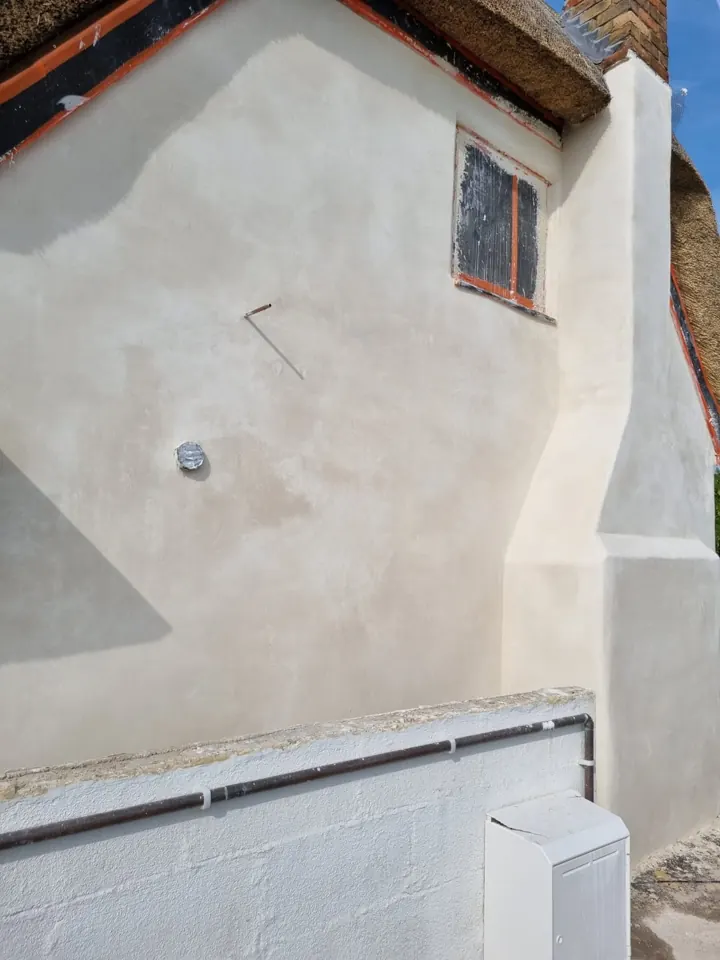
The leak that does most damage is the one you cannot see. The feed to an outside tap passes through the wall. If a joint in that section fails or the pipe corrodes, the water runs into the masonry instead of onto the patio. The regulations say no water fitting should be embedded in any wall (opens in a new tab)1, and a joint must not be concealed inside one. In practice that means one continuous length of pipe through a sleeve, with the joints either side where you can reach them.
In a solid stone or brick house, a slow leak into the wall shows up as a damp patch on the inside face. Look too for bubbling paint or salts low down, or a musty smell in the cupboard behind the tap. SPAB's guidance on dampness describes plumbing leaks as producing localised stains, sometimes with a fan-like pattern (opens in a new tab)4, with moisture that has nothing to do with the weather.
A customer in GL6, in the Stroud valleys, had exactly this problem. Another plumber had said the job was too much hassle, and the customer told us: "The old pipe had been leaking into my limestone walls and the tap didn't work." We replaced the leaking outdoor tap and, in their words, "Now everything's fixed, no more leaks." It is typical of the plumbing work we do around Stroud, where so many houses are solid stone.
Local note
Limestone walls and hidden leaks
Much of the older building across the Cotswolds is the area's Jurassic oolitic limestone (opens in a new tab)5, used for houses and walls for centuries. Like other traditional walling, SPAB notes (opens in a new tab)4, it takes in more moisture than modern materials and gives it up again as it dries. Once a leak is fixed, the wall needs time to dry. Do not seal the damp patch with cement or plastic paint; our guide to damp in old houses explains why.
Getting an outside tap ready for winter
An outside tap left full of water through a frost can split its body or its check valve. Often the first you know about it is a spray in April. Five minutes in autumn prevents it.
- Disconnect the hoseTake off the hose and any connector, and drain the hose so it does not crack.
- Close the indoor valveShut the isolating valve inside so the pipe through the wall is no longer under pressure.
- Open the tap and leave it openLet the trapped water drain out, and leave the tap open so any drips can escape rather than freeze.
- Fit an insulated coverA cheap foam tap cover keeps the worst of the wind off the tap body.
- Lag the indoor sectionLag the short pipe between the valve and the wall, which sits in the coldest corner of the room.
If the tap has already frozen
Close the indoor valve first, then thaw the tap gently with a cloth soaked in warm water, never a flame. Check the tap body and the pipe for splits before you open the valve again. Our guide to stopping pipes freezing covers the rest of the house.
Outside tap installation: what a proper job includes
Fitting a new outside tap is a modest job, but it connects to the drinking water supply, so the backflow and frost rules apply. A sound installation has these parts:
- A tee off the cold mains supply inside, with an isolating valve you can reach easily
- A double check valve on the indoor side, on the warm side of the wall
- A way to drain the outside section for winter
- One continuous length of pipe through the wall in a sleeve, with no joints hidden inside it
- A wall plate or bracket fixed firmly into sound masonry, so the tap does not twist when you use it
- The hole made good to match the wall, which on old stone means lime mortar rather than cement
When to call a plumber
Call a plumber if the leak is at or inside the wall, or if there is damp indoors near the tap. Call too if the isolating valve or stopcock will not hold, or the tap or pipe has split in a frost. The same goes for a new tap fitted with proper backflow protection. Our plumbing repairs service covers all of these. If a split feed is spraying and you cannot isolate it, treat it as urgent and call us about an urgent leak. If the outside tap is one of several small jobs on your list, our property maintenance visits can handle them together.
For a leaking or broken outside tap, a new tap with proper backflow protection, or a damp patch you suspect is the pipe, send us the details. You can also call 07858 305739, Monday to Friday, 9am to 5pm.
Sources and further reading
- The Water Supply (Water Fittings) Regulations 1999, Schedule 2 (opens in a new tab), legislation.gov.uk. Paragraph 15: every water system must contain adequate backflow prevention suited to the fluid category; paragraph 7: no fitting embedded in a wall and no concealed joints
- Hose union taps (opens in a new tab), Water Regs UK. Garden hoses are typically fluid category 3, protected by a double check valve installed inside for homes built after 1 July 1999; built-in check valve taps only if installed before that date; outdoor check valves prone to freezing; high-risk hoses fluid category 5
- The Water Supply (Water Fittings) Regulations 1999, regulation 5 (opens in a new tab), legislation.gov.uk. A garden watering system not designed to be operated by hand must be notified to the water undertaker before installation
- Control of Dampness, SPAB Technical Advice Note (opens in a new tab), Society for the Protection of Ancient Buildings. Plumbing leaks produce localised stains, sometimes with a fan-like pattern, with moisture unrelated to the weather; traditional walling takes in more moisture than modern materials but lets it evaporate
- Geology of the Cotswolds (opens in a new tab), Cotswolds National Landscape. The Cotswolds are underlain by Jurassic oolitic limestone, used for buildings and walls for centuries
- Approvals directory: hose union taps (section 1780) (opens in a new tab), Water Regulations Approval Scheme (WRAS). Public listing of WRAS-approved hose union taps, with notes where the complete product has not been tested as backflow protection
Sources checked on 4 November 2026.
About this guide
Written by the team at CLA Developments, who do plumbing, heating, building and tiling work across Gloucestershire and the Cotswolds, and reviewed by Alistair Hunt, who leads the team on site. Customers on Checkatrade (opens in a new tab) mention him by name for bathroom refits, tiling and plumbing repairs. The facts were checked against the sources listed above. This is general guidance, not a survey of your home. Gas work must be done by a Gas Safe registered engineer, new electrical circuits by a qualified electrician, and structural changes need a structural engineer and building control. Spotted something out of date? Email us and we will correct it.
More questions
Can't see yours? Call or email and you'll speak to the people who do the work.
Swapping a like-for-like tap onto an existing feed that has its own isolating valve is a reasonable DIY job: isolate, drain, unscrew, reseal the thread with PTFE tape and refit. Anything that cuts into the supply, adds a new tap, or disturbs the pipe through the wall is better left to a plumber. The backflow and frost rules apply, and a bad joint inside the wall can leak unseen.
Yes. A constant drip wastes water, stains paving and keeps the ground at the base of the wall wet, which matters on old solid walls. The usual fix is a new washer, which costs very little in parts. If the tap is old and the seat is badly pitted, replacing the whole tap is often quicker and more reliable than repeated repairs.
Most domestic outside taps in the UK are half-inch BSP, fed from 15mm copper or plastic pipe, with a threaded outlet for a hose connector. Three-quarter-inch taps exist for higher flow. Check the old tap and the wall plate before buying a replacement, and choose one approved for use on a drinking water supply. The WRAS approvals directory (opens in a new tab)6 lists approved hose union taps. Some listings note that the complete tap has not been tested as backflow protection, so a built-in check valve is not proof of protection; fit a separate double check valve indoors.
An ordinary hand-held hose tap does not need notifying to the water undertaker. The work must still meet the Water Fittings Regulations, which means backflow protection and frost protection. An automatic garden watering system that is not operated by hand does need notifying before installation. If your house is listed, ask the council's conservation officer before drilling a new hole through an old wall.
Almost always a worn washer or a damaged seat, so the tap cannot close fully. Occasionally the washer has come loose from the jumper and sits crooked. Isolate the tap, take out the headgear and look: a split, flattened or missing washer is obvious. If the seat is badly scored, a new tap will stop the problem for good.
Keep reading
Water pressure, taps, toilets, showers, leaks and frozen pipes.


Free quotes & advice
Get a no-obligation quote and straight answers about your project. Tell us about the job and we will give you straight answers and a clear written quote.
Book a site visitLines open Monday to Friday, 9am to 5pm