
What pressure should my boiler be? Reading the gauge and fixing it
Most boilers should read 1 to 1.5 bar cold and up to about 2 bar hot. What each reading means, how to top up safely and when it's a job for an engineer.
Most sealed-system boilers should read between 1 and 1.5 bar when cold, rising to around 2 bar when hot. Below about 1 bar the boiler may stop and needs topping up through the filling loop. Near the 3 bar limit the safety valve can open. Topping up more than twice a year points to a leak.
Key points
- Read the gauge with the heating off and cold: 1 to 1.5 bar is normal for most modern boilers, and a rise of a few tenths of a bar when hot is expected.
- Topping up with the filling loop is a homeowner job; close both valves fully and disconnect a loose hose afterwards so it can't creep the pressure up.
- A drop straight after bleeding radiators is normal on a sealed system. A drop with no radiator bleeding means water is escaping somewhere.
- A dripping copper pipe outside, or pressure that swings by more than 1 bar between cold and hot, usually means the relief valve or expansion vessel needs an engineer.
- Never open the boiler casing or touch the pressure relief valve; anyone working on a gas appliance must be on the Gas Safe Register.
Boiler pressure questions tend to arrive on a cold morning, when the heating won't fire and the needle on the front of the boiler is sitting somewhere near zero. The good news is that low pressure is usually the easiest boiler fault to put right yourself, and the gauge tells you a lot about what is going on inside the system. This post covers the readings that are normal with the heating on and off, how to top up with the filling loop, how to bring high pressure down, why pressure keeps dropping, and where the line sits between a homeowner job and one for a heating engineer.
What pressure should a boiler be with the heating on and off
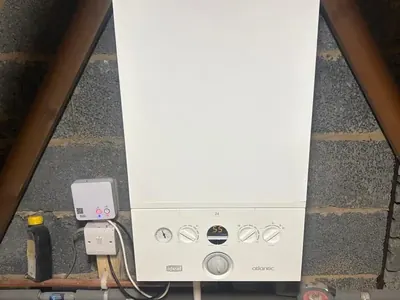
Check the gauge when the heating has been off for a while and the radiators are cold. Worcester Bosch says a cool system should read between 1 and 1.5 bar (opens in a new tab)1, usually shown as the green band on the gauge. Vaillant gives the same 1 to 1.5 bar range with the heating off and says it will usually sit between 1 and 2 bar when running (opens in a new tab)2, staying below the 3 bar upper limit.
The rise when hot is normal. Water expands as it heats, and a sealed system has nowhere for that extra volume to go except into the expansion vessel, so the needle climbs a little. Baxi describes the normal operating range as 1.0 to 2.0 bar and says it should not go higher than about 2.5 bar (opens in a new tab)3. Your own boiler manual has the final say, because the exact limits vary by model.
| Gauge reading | What it usually means | What to do |
|---|---|---|
| Below 0.5 bar | Water has been lost and the boiler may lock out | Top up with the filling loop, then look for the cause |
| 0.5 to 1 bar (cold) | Slightly low, may stop the boiler on some models | Top up to 1 to 1.5 bar |
| 1 to 1.5 bar (cold) | Normal resting pressure | Nothing |
| 1.5 to 2 bar (hot) | Normal rise as water expands | Nothing |
| Over 2.5 bar (cold) | Overfilled, or a filling valve letting water by | Bleed a radiator to bring it down |
| Near 3 bar or dripping pipe outside | Safety valve opening | Switch off and call an engineer |
How to repressurise a boiler with the filling loop
Topping up is a user-level job that boiler makers expect you to do yourself. Viessmann's steps are the standard sequence, and they start with turning the boiler off and letting the water cool (opens in a new tab)4 for at least an hour. Most filling loops are a short braided hose with a valve at each end, under the boiler. Some boilers have a built-in filling link or key instead, so check the manual for yours before you start.
- Turn the boiler off and let it coolHot water reads higher on the gauge, so topping up a hot system leaves it underfilled once it cools.
- Find the filling loop and check its typeA loose braided hose connects between two valves. An integral filling link or key is operated from under the boiler as the manual shows. If the manual tells you to remove the casing, stop and call an engineer.
- Connect the hose hand-tightIf your loop is a removable hose, screw it onto both valves by hand so the washers seal.
- Open the valves slowlyOpen one valve, then the other. You'll hear water flowing. Watch the gauge the whole time.
- Stop between 1 and 1.5 barClose both valves fully as soon as the needle reaches the target, one after the other.
- Disconnect the hoseUndo both ends with a towel underneath to catch drips. A valve left slightly open, or a worn one, can slowly push the pressure too high.
- Restart and recheckTurn the boiler back on, press reset if it shows a fault, and check the reading again once the heating is hot.
Why is my boiler losing pressure?
Pressure only falls when water leaves a sealed system or air is let out of it. Viessmann gives leaks and recently bled radiators (opens in a new tab)4 as the two main causes, and Worcester Bosch's checks for a system that keeps losing pressure (opens in a new tab)5 start with visible joints, radiator valves and the relief valve pipe outside. Worcester Bosch says a top-up is usually needed once or twice a year, and that topping up much more often is a reason to contact your installer.
Use the pattern of the drop to narrow it down. A slow loss over days with no water in sight is usually a weeping radiator valve or a pipe joint under a floor. Look for green or white crust on valve tails, brown rings on ceilings below radiators, and damp patches at skirting level.
Leaks on radiators, valves and pipework are plumbing jobs rather than gas work, and you'll find that side of things on our heating repairs and radiator work page. If the fault looks like it is inside the boiler, our boiler repair service explains how a breakdown visit works. Call us about it and we'll tell you straight whether the job is one for us. Whoever opens the casing, ask to see their Gas Safe ID card first.
| What you notice | Likely cause | Who deals with it |
|---|---|---|
| Dropped right after bleeding radiators | Air out, water not yet replaced | You: top up once |
| Slow drop over days, no visible water | Weep at a valve or a joint under the floor | You can check valves; a plumber traces hidden leaks |
| Drips or staining under the boiler | Leak inside the boiler or at its valves | Gas engineer; leave the casing on |
| Copper pipe outside drips after the heating runs | Pressure relief valve discharging | Engineer; often an expansion vessel fault |
| Swings more than 1 bar from cold to hot | Expansion vessel has lost its air charge | Engineer to recharge or replace it |
| Climbs on its own with the heating off | Filling loop valve letting water by | You: close valves, remove hose; engineer if it persists |
Trade tip
Hidden leaks in solid floors and stone walls
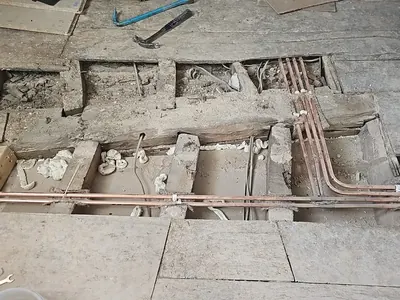
In our experience, older stone houses and cottages often have heating pipes buried in solid floors or chased into walls. A slow leak there may never drip anywhere you can see. Instead it shows as a damp patch, flaking paint or salts on the wall, and on lime-plastered walls the damp can spread well beyond the leak. If the pressure is falling and you've ruled out the obvious, our leak guide explains how to narrow it down.
Boiler pressure too high: how to bring it down safely
High pressure is most often caused by overfilling during a top-up, or a filling valve that is no longer shutting off fully. Vaillant lists both, plus a faulty boiler, and advises that if the reading at room temperature is under 2.5 bar no action is needed (opens in a new tab)2. Above that, bring it down before you use the heating. Worcester Bosch treats about 2.75 bar or more as too high.
Let the system cool first, so you're reading the true resting pressure. Then bleed a radiator, ideally one downstairs, with a cloth around the key. Open the bleed screw a quarter turn and let water out in short bursts, checking the gauge between each one, until it reads 1 to 1.5 bar. Check that both filling loop valves are fully closed and the hose is off.
When to call a professional
Leave the relief valve alone
The pressure relief valve is a safety device that discharges water if the pressure gets too high (opens in a new tab)3, and Vaillant gives 3 bar as the upper limit. The water goes down a pipe, usually to the outside. Do not try to let pressure off through it yourself: the water that comes out can be very hot. If the pressure keeps climbing after you've bled a radiator and closed the filling loop, switch the boiler off and call an engineer.
Why bleeding a radiator drops the pressure on a combi
Most DIY guides tell you to bleed radiators without mentioning this. A combi or system boiler runs a sealed circuit with a fixed amount of water. When you open a bleed screw, the air that comes out was taking up space inside that circuit. Once it's gone, the air cushion in the expansion vessel pushes water into the space it left, and as that cushion expands the pressure on the gauge falls. In our experience, bleeding three or four radiators on a sealed system can drop the gauge by a noticeable amount, so check it after each one.
Older open-vented systems with a regular boiler behave differently. A small feed and expansion tank in the loft tops the circuit up by gravity, so bleeding a radiator doesn't need a top-up and the boiler usually has no pressure gauge at all. If you're not sure which you have, our comparison of combi, system and regular boilers explains how to tell them apart.
The practical rule is to check the gauge every time you bleed. Bleed with the heating off and cool, work from the radiator nearest the boiler outwards, then top up once at the end. Our post on bleeding a radiator properly has the full method.

What you can do yourself and what needs an engineer
The line is simple. Anything the manual tells a householder to do is fine: reading the gauge, using the filling loop, resetting the boiler, bleeding radiators and checking radiator valves for drips. Anything inside the boiler casing, or involving gas, is not. HSE says anyone employed to work on gas appliances in a home must be on the Gas Safe Register (opens in a new tab)6, and that registered engineers carry ID cards listing the appliances they can work on. Ask to see the card and check that it lists the type of appliance you need worked on.
- Do it yourself: top up with the filling loop, bleed radiators, reset the boiler, tighten a radiator valve gland nut by a quarter turn if it weeps.
- Call an engineer: drips from the boiler, a dripping relief valve pipe outside, pressure swinging more than 1 bar, any fault code that returns after a reset.
- Call a plumber: damp patches on ceilings or walls, crusted valve tails, a suspected leak under floors.
Safety first
Gas smell or carbon monoxide symptoms
Pressure faults are not a gas emergency. If you smell gas, HSE advises calling the Gas Emergency Freephone on 0800 111 999, opening doors and windows, and turning the gas off at the meter if you know where it is. The NHS says (opens in a new tab)7 carbon monoxide symptoms such as a headache, dizziness, feeling sick, tiredness and shortness of breath may get worse in an affected room and get better when you leave or go outside. If you think a gas appliance is leaking carbon monoxide, stop using it, go outside, call the free National Gas Helpline on 0800 111 999 and get medical advice as soon as possible. Our guide to carbon monoxide alarms has more.
Keeping pressure steady: the expansion vessel and annual service
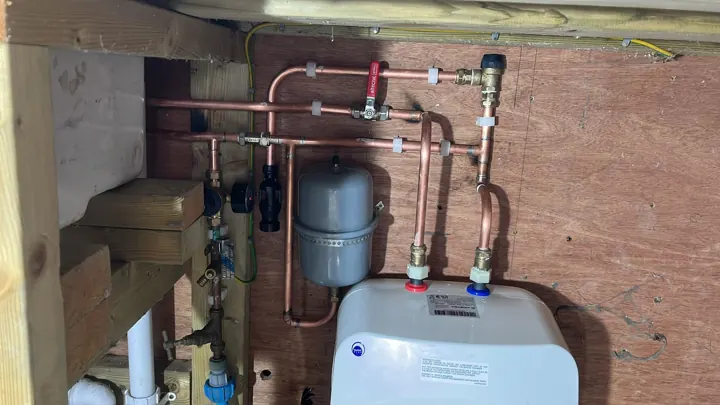
The expansion vessel is a steel tank with a rubber diaphragm and a cushion of air on one side. It absorbs the extra volume when the water heats up. Over the years that air charge slowly leaks away, and the system starts behaving badly: low pressure when cold, high pressure when hot, and the relief valve dumping water outside, which then drops the pressure again. Worcester Bosch says a rise of more than 1 bar as the heating warms up means the vessel may need repressurising by an engineer.
Checking the vessel charge is part of a proper service, along with the relief valve and the gauge itself. A yearly boiler service is the time to have it looked at, and our post on how often a boiler should be serviced covers what that visit should include. If the boiler is old and pressure faults keep coming back, it's worth reading how long a boiler lasts before paying for repeated repairs.
Many older houses around Stroud and the valleys have heating that has been extended and altered over the decades. Every radiator added puts more water in the circuit, and a vessel sized for the original system may no longer cope with the extra expansion. If you've had an extension or extra radiators fitted, mention it when you book so the engineer checks the vessel size as well as its charge.
If your boiler keeps losing pressure, call us on 07858 305739 (Monday to Friday, 9am to 5pm) or send us the details, and we'll look for where the water is going before anyone tops it up again.
Sources and further reading
- Boiler pressure: how often should I top up the pressure in the heating system (opens in a new tab), Worcester Bosch. 1 to 1.5 bar when cool; below 0.5 bar means water lost; about 2.75 bar too high; top up once or twice a year; a rise of more than 1 bar when hot means the expansion vessel may need an engineer
- What pressure should my boiler be? (opens in a new tab), Vaillant. 1 to 1.5 bar off, 1 to 2 bar on, below 3 bar; expansion is normal; high pressure causes; under 2.5 bar at room temperature needs no action
- What should my boiler pressure be set at (opens in a new tab), Baxi. Normal operating pressure 1.0 to 2.0 bar, not above about 2.5 bar; safety valve discharges water if too high
- What to do if your boiler pressure is too low (opens in a new tab), Viessmann. Repressurising steps: turn off and cool for an hour, open both valves, close them, restart, undo the loop from both ends; leaks and recently bled radiators as the two main causes of low pressure
- The heating system is constantly losing pressure, what should I do? (opens in a new tab), Worcester Bosch. When pressure keeps falling, check visible joints and radiator valves for leaks and check the pressure relief valve pipe outside for dripping
- Gas safety: frequently asked questions (opens in a new tab), Health and Safety Executive. Gas engineers must be on the Gas Safe Register and carry ID cards; Gas Emergency Freephone 0800 111 999 and what to do if you smell gas
- Carbon monoxide poisoning (opens in a new tab), NHS. Carbon monoxide symptoms, that they may get better when you leave or go outside, what to do, and the National Gas Helpline 0800 111 999
Sources checked on 4 November 2026.
About this guide
Written by the team at CLA Developments, who do plumbing, heating, building and tiling work across Gloucestershire and the Cotswolds, and reviewed by Alistair Hunt, who leads the team on site. Customers on Checkatrade (opens in a new tab) mention him by name for bathroom refits, tiling and plumbing repairs. The facts were checked against the sources listed above. This is general guidance, not a survey of your home. Gas work must be done by a Gas Safe registered engineer, new electrical circuits by a qualified electrician, and structural changes need a structural engineer and building control. Spotted something out of date? Email us and we will correct it.
More questions
Can't see yours? Call or email and you'll speak to the people who do the work.
Low pressure is not dangerous in itself. The boiler senses it and shuts down to protect itself, which is why you lose heating and hot water. The real risk is the cause: water escaping from a pipe or valve can damage ceilings, floors and walls over time. Top up, then watch the gauge for a week. If it falls again, find the leak.
Yes. Water expands as it heats, so the gauge normally climbs a few tenths of a bar once the radiators are hot and drops back as they cool. Vaillant says this is completely normal. If it rises by more than about 1 bar from cold to hot, the expansion vessel has probably lost its air charge and needs an engineer.
Worcester Bosch says a sealed heating system usually needs topping up once or twice a year. Needing to do it every few weeks is not normal. It means water is leaving the system, through a leak, a weeping valve or a relief valve that keeps opening, and in our experience adding more water each time brings in fresh oxygen that speeds up corrosion inside radiators.
If your loop is a removable braided hose, disconnect it after use. Viessmann tells you to undo the loop from both ends once the valves are closed. A valve that is not fully shut, or has worn, can keep feeding water in and push the pressure up towards the relief valve. Built-in filling links stay in place, so just make sure they are fully closed.
For most combis, 0.7 bar with the heating cold is on the low side and worth topping up to between 1 and 1.5 bar. The point at which a boiler actually locks out varies by make and model, so some keep running at that reading and others stop. Your manual will give the minimum, and Worcester Bosch treats anything below 0.5 bar as water lost.
Keep reading
Boilers, radiators, cylinders, heat pumps and underfloor heating.


Free quotes & advice
Get a no-obligation quote and straight answers about your project. Tell us about the job and we will give you straight answers and a clear written quote.
Book a site visitLines open Monday to Friday, 9am to 5pm