
Air source heat pump installers in Gloucestershire
Honest advice on whether a heat pump suits your home, then a system designed for low flow temperatures.
Listed on Checkatrade Member of the Association of Master Tradesmen Registered company 16784817 (opens in a new tab) Email photos of the job for a quote
An air source heat pump takes heat from the outside air and delivers it at a low flow temperature, so it suits homes with good insulation and the right radiators or underfloor heating. CLA Developments gives honest advice on suitability first, then plans the system, cylinder and pipework across Gloucestershire. Every job starts with a free site visit and quote.
“Great service, Alistair was friendly and pleasant and the job was completed to a high standard.” Checkatrade review, GL50. More reviews
If you are comparing air source heat pump installers in Gloucestershire, start with one who will tell you honestly whether your house is ready. CLA Developments plans heat pump systems, the radiators or underfloor heating they feed, and the cylinder and pipework upgrades they need, across the county including Gloucester, Cheltenham, Stroud and Cirencester. A heat pump can heat a home well and cheaply, but only when the house, the emitters and the flow temperature are right. We look at all of that before talking about equipment, and we explain running costs in plain terms first.
Is your house ready for an air source heat pump?
Your house is ready for an air source heat pump when it holds its heat well, its radiators can warm the rooms at a lower flow temperature, and there is space for a hot water cylinder and the outdoor unit. A heat pump takes heat from the outside air and moves it into your heating and hot water. It works best delivering a steady, lower temperature for longer periods, which is a different rhythm from a boiler that blasts heat for an hour in the morning and evening.
Suitability comes down to a handful of practical checks: how much heat the house loses, whether the radiators are big enough to warm rooms at a lower flow temperature, whether there is space for a hot water cylinder, and where the outdoor unit could sit. If any of those are weak, the fix may be insulation or bigger radiators first, and we will say so rather than sell you a system that struggles.
For a deeper look at older properties, read our guide to heat pumps in older homes.
| Check | What we look at | If it falls short |
|---|---|---|
| Heat loss | A room-by-room calculation using the walls, floors, roof, windows and air leakage | Top up loft insulation, seal draughts and lag the cylinder and pipes first |
| Radiators | Whether each radiator warms its room at the planned lower flow temperature | Larger or double-panel radiators, or underfloor heating |
| Hot water | Space for a heat pump cylinder, the floor strength and the pipe route | Find room in an airing cupboard, loft space or utility |
| Outdoor unit | A solid base, free airflow, a short pipe run and noise kept away from bedrooms and neighbours | Check the conditions with your local planning authority, especially for listed buildings and conservation areas |

Insulation and heat loss come first
We start with a room-by-room heat loss calculation, using the walls, floors, roof, windows and air leakage of each room. That number sizes the heat pump and every radiator or underfloor loop. Guessing it is a common reason heat pumps disappoint.
The cheapest improvements usually come first: loft insulation topped up, draughts sealed around doors, windows and floorboards, and cylinder and pipe lagging. Each one reduces the size of heat pump you need and the cost of running it.
Before your heat pump survey
- Find your Energy Performance Certificate if you have one
- Check your loft insulation depth
- Note rooms that are hard to heat now
- Look for space for a hot water cylinder
- Think about where an outdoor unit could sit
- Check current grant eligibility on GOV.UK
- Tell us if the house is listed or in a conservation area
Radiator sizing and low-temperature heating
Low-temperature heating is the heart of a good heat pump install. The lower the flow temperature, the more efficiently the heat pump runs. But a radiator sized for a boiler running hot water will give out much less heat at a heat pump's lower flow temperature, so some rooms may need larger radiators, double-panel radiators or underfloor heating.
We check each room's radiator against its heat loss at the planned flow temperature and only change the ones that need it. Pipework matters too: microbore pipe common in older systems can restrict flow, so some runs may need upsizing. Our radiator and heating system work covers these upgrades, whether or not you go ahead with a heat pump straight away.

Cylinder space and outdoor unit location
Most heat pump systems need a hot water cylinder with a coil designed for heat pumps, so a combi boiler home will need room for one, usually in an airing cupboard, loft conversion space or utility. We check the space, the floor strength and the pipe route at the survey.
The outdoor unit needs a solid base, free airflow around it and a position that keeps noise away from bedrooms and neighbours. Shorter pipe runs to the house are better. Many installations fall under permitted development, but there are conditions, and listed buildings and conservation areas need more care, so check with your local planning authority or the Planning Portal before committing.
Running costs and government grants
We will not quote running cost figures here, because they depend on things that vary from house to house. The main factors are how much heat the house loses, the flow temperature the system runs at, how efficient the heat pump is over a whole year, the electricity tariff you are on and how you use the controls. A well-designed system running at a low flow temperature on a suitable tariff can compare well with gas. A poorly designed one running hot will cost more.
Government grants towards heat pumps do exist. Eligibility rules change, so check the current scheme details and whether your home qualifies on GOV.UK. Installers must meet the scheme's requirements for you to claim, so ask any installer what registrations they hold and check them yourself before signing anything.
Heat pumps in older Cotswold stone homes
Solid stone walls lose more heat than a modern cavity wall and need to breathe, so the usual cures do not always apply. Covering lime-plastered walls in modern insulation and cement can trap moisture and cause damp. Breathable materials, careful draught sealing and better loft and floor insulation tend to be safer starting points.
Many older homes can run a heat pump well with the right preparation, but some need more work than others. We work on homes like this in the stone villages around Cirencester and the Cotswold edge, and in the Victorian and Regency houses of Cheltenham. We will tell you honestly if your home needs fabric improvements first.
If you need a heat pump in Gloucester, the housing stock is more mixed, from Victorian terraces to newer estates that are often easier to convert. We cover homes across Gloucester and its villages. A customer in GL4 described Alistair as "courteous and efficient".
Pairing a heat pump with underfloor heating
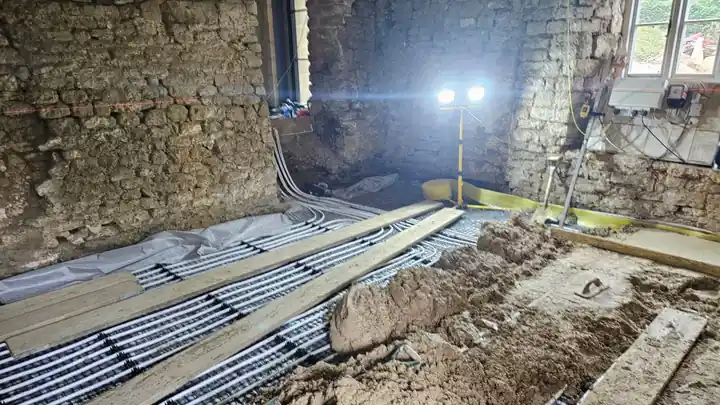
Underfloor heating suits heat pumps because it spreads gentle warmth across the whole floor, so it can heat a room at a lower water temperature than radiators. If you are building an extension or lifting floors anyway, designing the floor for a heat pump now saves work later. Our underfloor heating designed for heat pumps page explains floor build-ups, insulation and finishes.
Many homes end up with a mix: underfloor heating downstairs where floors are being renewed, and larger radiators upstairs. We plan both from the same heat loss figures so the whole system runs at one sensible flow temperature.
If you are considering a heat pump, ask us for an honest suitability survey and we will tell you what your home needs first and give you a written quote.
Free quote for a heat pump across Gloucestershire
- We reply within one working day, Monday to Friday, 9am to 5pm.
- A free, no-obligation site visit.
- A clear written quote before any work starts.
Prefer to talk it through? Call 07858 305739.
Tell us about the job
Two details and we'll call you back.
That didn't send, sorry. Please try again, or call 07858 305739.

What our plumbing and heating customers say
Great service, Alistair was friendly and pleasant and the job was completed to a high standard.
We highly recommend these guys - they did everything we needed & were a pleasure to deal with. Perfect - thank you!
Alistair did a fantastic job. He was courteous and efficient. Left the job in a tidy state. Reasonably priced. Would highly recommend.
I am very happy with the work that Alistair did for me. He came within one day of me contacting him. I highly recommended him to anyone who needs a reliable and competent plumber. I will definitely use him again in the future.
CLA Developments Ltd was incorporated in October 2025. Reviews dated before then, and any that mention AJH Plumbing and Heating, are from jobs done by the same team under its earlier trading name.
Guides about air source heat pumps
Straight answers from the people doing the work, written for homes in Gloucestershire.
Air source heat pumps in every town we cover
Pick your town for local detail on air source heat pumps there: the housing, what to expect and how quickly we can reach you.
Gloucestershire
- Heat pump installers in Gloucester
- Heat pump installers in Cheltenham
- Heat pump installers in Stroud
- Heat pump installers in Cirencester
- Heat pump installers in Tewkesbury
- Heat pump installers in Nailsworth
- Heat pump installers in Wotton-under-Edge
- Heat pump installers in Forest of Dean
- Heat pump installers in Bishop's Cleeve
- Heat pump installers in Dursley
- Heat pump installers in Tetbury
- Heat pump installers in Cinderford
- Heat pump installers in Coleford
- Heat pump installers in Moreton-in-Marsh
Worcestershire
Herefordshire
South Gloucestershire
Wiltshire
Four steps from first call to finished job
The same process whether it's a new tap or a full extension, so you always know what happens next.
- 01
On-site survey
We come out, look at the job properly and talk through what you want, including any drawings you already have.
- 02
Clear quote
A written quote with the work, the price and a realistic schedule. No obligation and no surprises later.
- 03
Design & layout
We agree the layout, materials and finishes with you before anything is ordered or removed.
- 04
Installation & work
One team carries out the work, keeps the site tidy and checks everything with you at the end.

Reviewed on Checkatrade
Every review on this site comes from a real customer.

Master Tradesmen
Members of the Association of Master Tradesmen.
Qualified tradespeople
Fully qualified, with years of hands-on experience on every job.
Guaranteed work
Guarantees on materials and workmanship.
Air source heat pumps: your questions answered
Can't see yours? Call or email and you'll speak to the people doing the work.
Often, yes, but it depends on heat loss, radiator sizes and the flow temperature the system can run at. Many older homes need insulation, draught sealing or larger radiators first. We do a room-by-room heat loss calculation at the survey and tell you honestly what would need to change before a heat pump makes sense.
Usually not all of them. Each room's radiator is checked against its heat loss at the planned flow temperature, and only those that cannot keep up need replacing. Some rooms may need a larger or double-panel radiator. Old microbore pipework may also need upsizing to carry enough flow.
Government grants towards heat pumps exist, but eligibility rules change. Check the current scheme and whether your home qualifies on GOV.UK. Installers must meet the scheme's requirements for you to claim, so ask any installer which registrations they hold and check them yourself before you commit.
The main factors are how much heat your home loses, the flow temperature the system runs at, the heat pump's efficiency across the year, your electricity tariff and how you use the controls. A well-designed system at a low flow temperature runs far more cheaply than one forced to run hot to keep up.
In most cases, yes. A heat pump usually heats a stored cylinder with a coil designed for heat pumps, rather than heating water instantly like a combi boiler. If you have a combi now, you will need space for a cylinder, usually in an airing cupboard, utility or loft space.
It needs a solid level base, free airflow and a position that keeps noise away from bedrooms and neighbours, ideally close to where pipes enter the house. Many installations fall under permitted development but there are conditions, so check with your local planning authority or the Planning Portal, especially for listed buildings.
Underfloor heating suits heat pumps well because it can heat rooms at a lower water temperature. Correctly sized radiators also work. Many homes use underfloor heating where floors are being renewed and larger radiators elsewhere, all designed to the same flow temperature.
The heat loss of your home sets the size of the heat pump, and that drives much of the cost. Radiators may need upsizing, older or narrow pipework may need replacing, and most homes need a new hot water cylinder. Where the outdoor unit goes, the electrical supply, any insulation work and the planning rules for the unit also count. We give a clear written quote after a free site visit.
Free quotes & advice
Get a no-obligation quote and straight answers about your project. Whether it is a dripping tap, a cold radiator or a new bathroom, we will look at the job and tell you plainly what it needs.
Book a site visitLines open Monday to Friday, 9am to 5pm