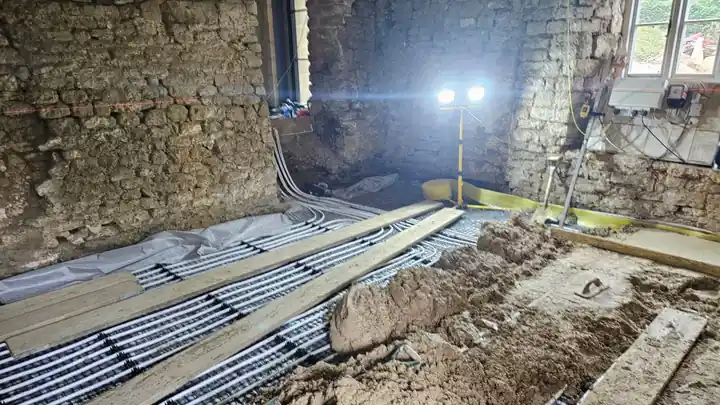
CLA Developments regularly works in Cheltenham as heat pump installers, sizing every radiator and outdoor unit position before quoting. Regency stucco over a brick core, tall rooms and sash windows make heat pump design here a careful job, while post-war semis are often simpler. The survey visit and written quote cost you nothing.
“Alistair did a great job refitting and tiling a bathroom for us.”Checkatrade review, GL52. More reviews
Many people asking about air source heat pumps in Cheltenham live in a 1930s semi, a post-war house or a newer home in one of the outer suburbs, and these are often the better candidates. Cavity walls, a loft that can take more insulation and space for a hot water cylinder all help a heat pump do its job. A tall Regency townhouse is a harder case. We start with honest advice on running costs, then look at heat loss, radiator sizes, pipe sizes and where the outdoor unit can sit before suggesting anything. If a heat pump is not the right answer for your house yet, we will tell you.
Which Cheltenham homes are best suited to a heat pump?
Interwar, post-war and newer homes are usually the easiest fit, because a heat pump gives the best results at a low flow temperature, around the warmth of a bath rather than a kettle. That means the house needs to hold its heat, and the radiators need to be big enough to put out enough warmth at that lower temperature. Interwar and post-war houses with filled cavities, a well-insulated loft and double glazing usually get there with some radiator upgrades.
Solid-walled Victorian houses can work too, but expect more radiator changes and possibly some insulation work first. We calculate heat loss room by room rather than guessing from the size of the old boiler.
Regency houses are the hardest case. Solid brick behind stucco, tall rooms, big sash windows and often listed status limit the insulation you can add. A heat pump can still work, but radiators may need to be much larger, and we will be honest about running costs.
Outdoor units behind Regency terraces and on post-war estates
Where the outdoor unit goes often decides the job in Cheltenham. Behind a Regency terrace the garden may be narrow and walled, with bedroom windows close on both sides, and the unit still needs free airflow, a solid base, a condensate route and a short pipe run to the cylinder. On post-war estates such as Hesters Way and Up Hatherley there is usually more room at the side or back, though no-fines concrete walls need the right fixings for a wall bracket.
Many installations fall under permitted development, but there are conditions on noise, size and distance from the boundary. The town's seven conservation areas, led by the Central Conservation Area covering the centre and most of its Victorian suburbs, need more care, and a listed building needs consent. Check with Cheltenham Borough Council or the Planning Portal before committing.
Room-by-room heat loss calculation
Radiator and pipe sizing for low flow temperatures
Cylinder location, often where an airing cupboard once was
Outdoor unit position, base and condensate route
Controls set up so the system runs steadily
Before a heat pump survey in Cheltenham
Find out if the house is listed or in a conservation area, which limits where the outdoor unit can go.
Check the loft insulation depth and whether the cavity walls have been filled, common in interwar and post-war suburbs.
Work out where a cylinder could go, often the old airing cupboard.
Measure from the likely unit spot to your neighbours' windows.
If you live in a village off the gas grid east of the town, keep a year of oil bills to compare.
Have your energy bills and any recent EPC to hand.
That didn't send, sorry. Please try again, or call 07858 305739.
Postcodes
GL50 to GL53
Council
Cheltenham Borough Council
County
Gloucestershire
Typical homes
Historic town centre, Victorian and Edwardian suburbs, later 20th-century housing
Our cover
Regular cover, including urgent call-outs
Local conditions
What affects a heat pump in Cheltenham
The things about Cheltenham homes and ground that change how we plan and price this job, and what each one means for you.
Building materials
Stucco over brick on early 19th-century terraces such as Rodney Terrace (about 1809 to 1820), with slate roofs, some of them mansard, and cast and wrought iron railings and balconies.1
We match or work with the materials your house is actually built from, so the new work sits right with the original fabric and stays sound.
The town
Historic spa town beside the Cotswolds that claims to be the most complete Regency town in Britain.2
Older streets, steep or narrow access and parking all affect how a heat pump is planned in Cheltenham, so we look at access at the survey and build it into the timing and the written quote.
Typical homes
Historic town centre, Victorian and Edwardian suburbs, later 20th-century housing.3
Older and newer homes hide different things behind walls and under floors, so we plan a heat pump in Cheltenham around the house you have, not a standard job.
Cheltenham Borough Council is the planning authority for Cheltenham. We tell you early whether your job needs planning permission or building regulations approval, and who to apply to.
Word-for-word Checkatrade reviews from jobs in GL50 to GL53, each with the postcode the work was in.
Heating and plumbing
Great service, Alistair was friendly and pleasant and the job was completed to a high standard.
GL50, CheltenhamJanuary 2026
Bathroom refit
Alistair did a great job refitting and tiling a bathroom for us. The job was completed on time and Alistair even managed to fit in some additional small plumbing jobs which was really helpful. Alistair is straightforward and easy to work with.
GL52January 2026
Toilet leak repair (clean water).
Was able to repair quickly, when further issues developed came straight back and sorted. Left area clean, no parts left behind. Friendly, polite and professional.
Allistar has done an amazing job for my dad’s bathroom, turning it into a shower. He was reliable, professional and did a great job! Would recommend any day :) Thank you
ReliableGL51August 2025
Alistair fixed our staff toilet in the office and did a great job, everything was left very clean and tidy, and he was very efficient. Would highly recommend!
Would highly recommend!GL52July 2025
We’d been let down by other tradespeople so were really grateful when Alistair could come round and help us with a small plumbing job. Very friendly and prompt at replying - would certainly recommend
Friendly and prompt serviceGL52July 2025
CLA Developments Ltd was incorporated in October 2025. Reviews dated before then, and any that mention AJH Plumbing and Heating, are from jobs done by the same team under its earlier trading name.
Often, yes, once the basics are right. Filled cavity walls, good loft insulation and double glazing make a big difference, and some radiators will probably need to be larger. We calculate heat loss room by room and show you what needs to change before you decide.
Possibly, but check first. Permitted development rules for heat pumps have conditions, and in conservation areas and on listed buildings the position of the outdoor unit matters more. Check with your local planning authority or the Planning Portal before committing to an installation.
Government schemes do exist, but eligibility depends on the scheme rules at the time and on the installer's registrations. Check the current rules on the government website and confirm registrations with any installer before relying on a grant. We focus on honest advice about whether a heat pump suits your house.
Often it is worth a serious look. Many homes in the Cotswold villages east of the town run on oil, which changes the running cost comparison. We look at the house's heat loss and your current fuel use and give you an honest view. Check any grant eligibility, and the installer's registrations, before you commit.
The house itself. A Regency or Victorian villa with high ceilings and single-glazed sashes needs much more emitter area than a 1930s semi, so radiator upsizing is usually the biggest variable. Siting is next: in the Central Conservation Area and the other six conservation areas, a unit kept out of sight at the back may need a longer pipe run. Cylinder space, hard water scale protection and any listed building consent also count. We give a clear written quote after a free site visit.
Free quotes & advice
Get a no-obligation quote and straight answers about your project. Whether it is a dripping tap, a cold radiator or a new bathroom, we will look at the job and tell you plainly what it needs.