As heat pump installers across Gloucester, where we regularly work, CLA Developments fits air source systems in homes from modern estates at Kingsway to Victorian terraces off Barton Street. On the city's shrinking and swelling Lias clay we set units on a proper base. Book a free home survey and get honest advice and a written quote.
“Came over really fast and not the easiest tap to remove.”Checkatrade review, GL1. More reviews
Before fitting air source heat pumps in Gloucester, we start with honest advice on running costs, because a heat pump that suits one house can disappoint in the one next door. The things that decide it are how much heat the house loses, whether the radiators can do their job at lower water temperatures, and whether there is a sensible spot outside for the unit. Gloucester has a wide mix of houses, from cavity-walled semis to solid-brick terraces and modern estate homes. We survey yours, work out the heat loss room by room and tell you plainly whether a heat pump is a good fit.
Heat pumps across Gloucester's estates, semis and terraces
Houses on the former RAF Quedgeley land at Kingsway are the newest large estate in the city and the easiest place to make the case, because modern insulation keeps heat loss low. The snag is space: many have combis and no airing cupboard, so the hot water cylinder needs a home in a loft, garage or utility.
Abbeydale's 1960s and 1970s houses, and the Abbeymead homes that followed from 1986, have cavity walls that can usually be filled, and most have room at the side or rear for the outdoor unit. Matson's post-war houses are similar in build, though the sloping plots on the flanks of Robinswood Hill can make a level base and the pipe route more work.
The solid-brick Victorian terraces of Barton, Tredworth and Kingsholm lose heat faster and have small yards. A heat pump can still work, but draughtproofing, loft insulation and larger radiators usually come first. Our guide to heat pumps in older homes goes into this.
Radiators, flow temperatures and cylinders
A heat pump is most efficient when it heats water to a lower temperature than a gas boiler. At that lower temperature, each radiator gives out less heat, so some rooms need larger radiators to stay comfortable. We size each one from the heat loss calculation rather than guessing.
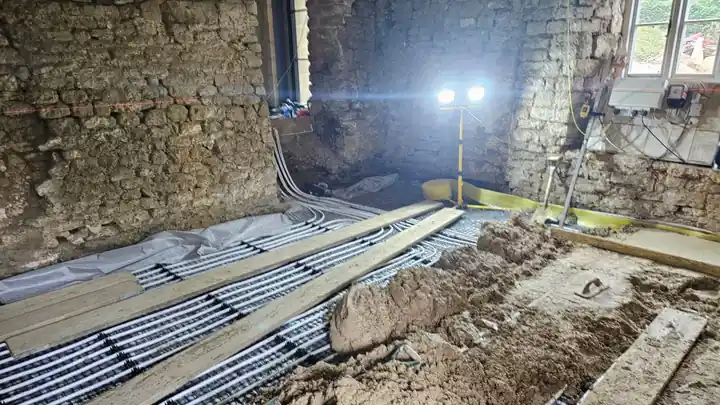
Hot water comes from a cylinder with a coil designed for heat pumps, which is larger than a boiler coil. Pipework may need upsizing in places, especially where an old system uses microbore. Where floors are coming up for a new extension or kitchen, underfloor heating laid in Gloucester floors is a natural partner because it runs at low temperatures anyway.
Room-by-room heat loss calculation
Radiator sizing at the planned flow temperature
Cylinder and pipework upgrades
Outdoor unit position, base and clearances
Controls set up for steady, low-temperature running
Before a heat pump survey in Gloucester
Find your EPC and check the loft insulation depth. Victorian terraces in Tredworth and Barton usually need draughtproofing before anything else.
Check whether your cavity walls have been filled. Look for a pattern of drill holes in the mortar, common on Abbeydale and Matson houses.
Measure a space for the cylinder. Kingsway combis often leave no airing cupboard.
Walk round the side and back and think about where a unit could sit with clearance from a neighbour's window.
Tell us if the house is listed or in a conservation area such as The Spa, Kingsholm or London Road.
If the garden sits on lower ground near the Severn, or slopes away below Robinswood Hill, note where a level, dry base could go.
Where can a heat pump go on a Gloucester terrace or estate plot?
Usually at the back on a concrete pad or wall brackets, but terraced streets off Barton Street and in Kingsholm have small back yards with neighbours close on both sides, so noise, airflow and the length of the pipe run all matter. On the city's Lias clay, which shrinks in dry summers and swells in wet winters, we set the unit on a proper concrete pad or wall brackets rather than a few slabs on soil, so it does not tilt over the years.
On lower ground near the Severn, in parts of Longford and Kingsholm, think about flood height. In 2007 the river at Gloucester matched its 1947 level, so a stand or brackets that lift the unit clear of likely flood water make sense. Planning rules allow many installations without permission, but listed buildings and the city's 14 conservation areas, such as The Spa and Denmark Road, need more care, so check with Gloucester City Council or the Planning Portal.
That didn't send, sorry. Please try again, or call 07858 305739.
Postcodes
GL1 to GL4
Council
Gloucester City Council
County
Gloucestershire
Typical homes
Victorian terraces, Regency Spa houses, post-war and modern estates
Our cover
Regular cover, including urgent call-outs
Local conditions
What affects a heat pump in Gloucester
The things about Gloucester homes and ground that change how we plan and price this job, and what each one means for you.
Building materials
Red brick, stone and stucco in the early nineteenth-century Spa and Brunswick Square, and timber-framed survivors such as the New Inn, a courtyard inn built around 1450.1
We match or work with the materials your house is actually built from, so the new work sits right with the original fabric and stays sound.
The town
A cathedral city on the River Severn with its historic docks at its heart, ringed by suburbs built over more than a century, from brick terraces near the centre to big estates at Quedgeley, Kingsway and Abbeymead.2
Older streets, steep or narrow access and parking all affect how a heat pump is planned in Gloucester, so we look at access at the survey and build it into the timing and the written quote.
Typical homes
Victorian terraces, Regency Spa houses, post-war and modern estates.2
Older and newer homes hide different things behind walls and under floors, so we plan a heat pump in Gloucester around the house you have, not a standard job.
Gloucester City Council is the planning authority for Gloucester. We tell you early whether your job needs planning permission or building regulations approval, and who to apply to.
Word-for-word Checkatrade reviews from jobs in GL1 to GL4.
Changed a kitchen tap
Came over really fast and not the easiest tap to remove. very happy to have a working tap now and will def use again for a few other jobs
GL1, GloucesterApril 2026
Bathroomupgrade
recently had my bathroom completely updated, including a new bath, shower installation, and tiling work, and I couldn’t be happier with the results. From start to finish, the service was professional, reliable, and of a very high standard. Everything was clearly explained before the work began, and the attention to detail throughout the project really stood out. The tiling in particular is neat and precise, and the overall finish has completely transformed the space. The work was completed on time, with minimal disruption, and everything was left clean and tidy at the end of each day.
GL4, GloucesterApril 2026
Gutted old bathroom including floor and timing then fitted new suite, floor, walls etc
I was so nervous about this project. I was on a tight budget but knew what I wanted and Andy was fantastic from start to finish. Super reliable, excellent communication, highly skilled and trustworthy I now have a gorgeous bathroom and can’t recommend him highly enough. Every tradesperson he used was excellent at their job and his supervision and advice made the whole process easy, and both time and cost efficient. Brilliant work, trustworthy, honest and hard working. I hope this review makes Andy blush, he should be proud.
Really good, was able to fit the tap and carried out further work to make sure everything was working smoothly.
Kitchen mixer tap installation.GL2October 2025
Had approx 8m2 of floor tiles installed, hallway and downstairs bathroom. Job included removal and refitting of vanity unit and back to wall toilet and the install of a new heated towel rail. Very helpful, efficient and friendly company who completed the job over the weekend to fit in with our plans. Would definitely recommend.
It can, but solid-brick terraces lose heat faster than newer houses, so insulation and draughtproofing usually come first, and some radiators may need to be larger. We calculate the heat loss and tell you honestly whether it will keep the house warm.
Yes. Air source heat pumps keep working below freezing, though efficiency drops as the outside temperature falls. Sizing the system for the coldest likely days, and setting the controls for steady running, keeps the house comfortable.
Often some can stay. Each room is checked against its heat loss at the lower flow temperature, and only the radiators that fall short are upsized. Rooms with plenty of radiator already may need nothing changed.
It can if the base is poor. Much of the city sits on Lias clay that shrinks in dry spells and swells when wet, so a unit on loose slabs can tilt and strain the pipe connections. We use a solid concrete pad set below the topsoil, or wall brackets on sound brickwork, and keep the unit clear of shrubs and trees that dry the ground out.
The age of the house drives most of it. A Kingsway home with modern insulation may keep most of its radiators, while a solid-walled Victorian terrace in Kingsholm needs more upsizing and better loft insulation. Small back yards can mean wall brackets or a longer pipe run, and Lias clay needs a proper concrete pad. In the Spa and other conservation areas, siting needs more thought. Cylinder space in combi houses also counts. You get a clear written quote after a free site visit.
Free quotes & advice
Get a no-obligation quote and straight answers about your project. Whether it is a dripping tap, a cold radiator or a new bathroom, we will look at the job and tell you plainly what it needs.