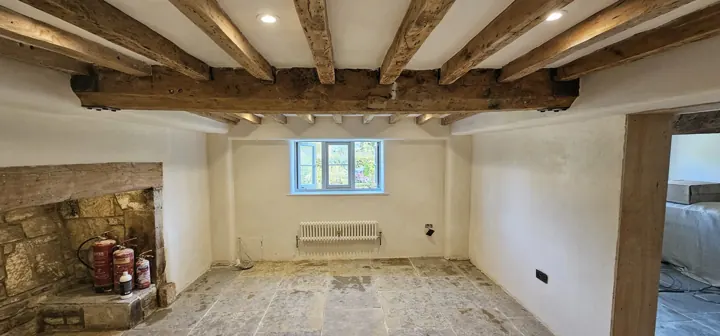
Looking for a plasterer in Gloucester? CLA Developments plasters walls and ceilings across the city, using lime on the solid brick of Victorian terraces in Kingsholm and Tredworth and a gypsum skim on plasterboard in newer estates such as Abbeymead and Kingsway. We make good after our own plumbers too. There is no charge for coming to see the room or for the quote.
“All the work was completed to a very high standard by Alaistair and Chris.”Checkatrade review, GL1. More reviews
A plasterer in Gloucester is usually called in to sort out a specific mess: a ceiling that cracked after a leak, chased walls after new pipework or wiring, or a room that needs a fresh skim before decorating. We plaster and make good across the city, from Victorian terraces with lath and plaster ceilings to modern homes built from plasterboard. Because we also do the plumbing, heating and building work, we can make good straight after our own jobs. That saves you finding another trade to close up the holes. Every job starts with a look at what is underneath.
Should a Gloucester house be plastered in lime or gypsum?
It depends on the wall: lime for solid Victorian and older brick, gypsum for plasterboard and blockwork. Victorian and older houses with solid brick walls were plastered in lime, which lets moisture move in and out of the wall. Patching these walls with gypsum or cement can trap damp and cause the new plaster to blow or stain. For repairs on old solid walls, we use lime, or a breathable alternative where it suits.
Interwar and later houses usually have gypsum plaster on blockwork or brick, and modern homes on the estates at Kingsway and Quedgeley are mostly plasterboard with a skim coat. These take a standard gypsum finish, and repairs are faster.
Lath and plaster ceilings in Kingsholm and Tredworth terraces
The terraces that filled Kingsholm, Barton and Tredworth from the 1840s were finished with lath and plaster ceilings, and many have now lost their key. When the plaster nibs behind the laths break, the ceiling sags, cracks along the joists and can eventually fall. A small area can be re-fixed with plaster washers and patched; where large parts are failing we take it down, re-board and skim. In the villas around Kingsholm Square and the early nineteenth-century houses of The Spa, cornices and ceiling roses are worth saving, so we work around them rather than boarding over.
Post-war houses bring a different problem. Much of Matson went up between the 1950s and 1970s and Abbeydale in the 1960s and 1970s, decades when textured ceiling coatings were popular, and some older coatings contain asbestos. Have them tested before anyone sands or scrapes. If the test is clear, we skim straight over the texture. If joists above were damaged by an old leak, our builders in Gloucester deal with them first.
Patching after plumbing, heating and electrical work
Full room skims ready for decorating
Lath and plaster ceiling repairs and replacements
Lime plaster repairs on solid brick walls
Skimming over textured ceilings once tested
Making good around new windows, doors and openings
Before we plaster in a Gloucester home
Tap the ceilings. A hollow sound or a bulge in a Victorian terrace ceiling means the lath and plaster has lost its key.
If a Matson or Abbeydale house has an old textured ceiling, arrange an asbestos test before we start.
In a listed house or one in The Spa or Kingsholm conservation areas, show us cornices, roses and original lime plaster you want kept.
Point out damp patches at skirting level. On solid brick walls, cement patches from past repairs often trap moisture.
If a room has flooded, tell us how high the water came and give the walls time to dry before we quote a finish.
On a Kingsway or Quedgeley house, note any cracks along plasterboard joints since handover, which are often drying shrinkage rather than structure.
Making good in Gloucester homes after leaks, floods and new kitchens
Plastering is often the last trade in a bigger job. After pipes are rerouted or a kitchen is replaced, the surfaces need making good before tiling or decorating, and doing it within the same job means the plasterer knows what is behind the wall.
Homes on lower ground near the Severn add another case. The river at Gloucester peaked at the same height in 2007 as in 1947, and after any flood, wet gypsum plaster usually has to be hacked off above the water line and the wall left to dry properly before replastering. On solid Victorian brick a lime or breathable finish copes better with moisture still leaving the wall.
That didn't send, sorry. Please try again, or call 07858 305739.
Postcodes
GL1 to GL4
Council
Gloucester City Council
County
Gloucestershire
Typical homes
Victorian terraces, Regency Spa houses, post-war and modern estates
Our cover
Regular cover, including urgent call-outs
Local conditions
What affects plastering in Gloucester
The things about Gloucester homes and ground that change how we plan and price this job, and what each one means for you.
Building materials
Red brick, stone and stucco in the early nineteenth-century Spa and Brunswick Square, and timber-framed survivors such as the New Inn, a courtyard inn built around 1450.1
We match or work with the materials your house is actually built from, so the new work sits right with the original fabric and stays sound.
The town
A cathedral city on the River Severn with its historic docks at its heart, ringed by suburbs built over more than a century, from brick terraces near the centre to big estates at Quedgeley, Kingsway and Abbeymead.2
Older streets, steep or narrow access and parking all affect how plastering is planned in Gloucester, so we look at access at the survey and build it into the timing and the written quote.
Typical homes
Victorian terraces, Regency Spa houses, post-war and modern estates.2
Older and newer homes hide different things behind walls and under floors, so we plan plastering in Gloucester around the house you have, not a standard job.
Word-for-word Checkatrade reviews from jobs in GL1 to GL4.
Alaistair and Chris are very professional and provided excellent workmanship.
All the work was completed to a very high standard by Alaistair and Chris. They also ensured that the property was left clean and tidy after finishing the job. The job included renovating the shower room and replastering the flat. Alaistair also returned to the flat immediately when there was a minor problem and sorted it out straight away. Thank you for completing a thoroughly professional job.
GL1, GloucesterJuly 2026
Pleased with the Finished Result
Happy with the job. The shower tray needed replacing and there was some uncertainty about possible water damage underneath, but everything was explained clearly before the work went ahead. The work was completed to a good standard, within excellent time, and the new shower is super sturdy. Thank you
GL3, GloucesterMay 2026
Changed a kitchen tap
Came over really fast and not the easiest tap to remove. very happy to have a working tap now and will def use again for a few other jobs
Really good, was able to fit the tap and carried out further work to make sure everything was working smoothly.
Kitchen mixer tap installation.GL2October 2025
Had approx 8m2 of floor tiles installed, hallway and downstairs bathroom. Job included removal and refitting of vanity unit and back to wall toilet and the install of a new heated towel rail. Very helpful, efficient and friendly company who completed the job over the weekend to fit in with our plans. Would definitely recommend.
Not straight away. New plaster needs to dry fully first, and the first coat should be a mist coat of watered-down emulsion or a suitable primer. Drying time depends on the thickness, the room and the weather. We tell you when it should be ready.
A bulge in a lath and plaster ceiling means the plaster has come away from the laths, and it can fall. Keep people out of the room and call us. We can usually secure it and then repair or replace the section.
Yes, on older solid-walled houses where the original plaster was lime. Lime lets the wall breathe and reduces the risk of trapped damp. On modern walls and plasterboard we use gypsum.
Not until the wall has dried, which can take weeks or months on solid brick. Wet gypsum plaster comes off first, usually to well above the water line, and the brickwork is left open with good airflow. We check moisture before replastering, and on older walls we often suggest lime, which tolerates some leftover dampness better than gypsum.
The size and height of the room, and what is underneath. A skim on sound plasterboard in a Kingsway or Abbeymead house is the simplest job. Lime on solid Victorian brick takes more coats and longer drying, and a lath ceiling that has lost its key may need securing or overboarding first. After flooding near the Severn, walls have to dry out before any plaster goes on, which affects timing. We confirm all this at a free site visit and send a clear written quote.
Free quotes & advice
Get a no-obligation quote and straight answers about your project. We're happy to help you plan a build or renovation so it runs efficiently.