
Can you put a heat pump in an older house?
Yes, many older houses, including Cotswold stone homes, can take a heat pump if the system is designed around a room-by-room heat loss calculation, with radiators or underfloor heating sized for low flow temperatures.
Yes, many older houses, including Cotswold stone homes, can take a heat pump if the system is designed around a room-by-room heat loss calculation, with radiators or underfloor heating sized for low flow temperatures. Some need fabric work first, such as draught-proofing, loft insulation or larger radiators, to stay comfortable at a sensible running cost.
Can you put a heat pump in an old house? Often yes, but it depends far more on the house than on the heat pump. We work on period and Cotswold stone homes across Gloucestershire, and the honest answer we give on surveys is that an air source heat pump works well in an older property when the heat loss, the radiators and the hot water are planned together. This guide explains what matters, which parts are the homeowner's job and which need a professional, and why some homes need fabric work before a heat pump goes in. We give running-cost advice before anything else.
Start with heat loss, not the heat pump
Every good heat pump design starts with a room-by-room heat loss calculation. It works out how much heat each room loses through its walls, floor, roof, windows and draughts on a cold day, which tells you the size of heat pump you need and the output each radiator or underfloor zone has to give.
Older homes vary a lot. A solid stone cottage with thick walls, single glazing and an open chimney loses heat very differently from a Victorian brick terrace or a 1930s semi with cavity walls. Guessing from the floor area or the size of the old boiler usually leads to an oversized unit or cold rooms, so ask any installer how they calculated the heat loss and to show you the figures room by room.
Insulation and draughts in older and Cotswold stone houses
Heat pumps run steadily at lower temperatures, so a house that leaks heat through gaps and an uninsulated loft will struggle. The cheapest gains are usually draught-proofing doors, windows and loft hatches, blocking unused chimneys with a ventilated cap or balloon, and topping up loft insulation. A homeowner can do much of this, or arrange it before the survey.
Solid stone walls need more care. Old stone and lime work need to breathe (opens in a new tab)5, and covering them with cement render or non-breathable insulation can trap moisture and cause damp. Where wall insulation makes sense on a stone house, breathable systems such as lime-based or wood-fibre products are usually the right direction, and this is the kind of work our period and stone home renovations cover. Ventilation still matters once a house is tighter.
Before a heat pump survey
- Gather a year of energy bills
- Note which rooms are hard to heat now
- Check your loft insulation depth and draughty spots
- Find out if the house is listed or in a conservation area
- Look for space for a hot water cylinder
- Think about where an outdoor unit could sit
- Check current grant eligibility on GOV.UK
- Ask for a room-by-room heat loss calculation
Do heat pumps work with radiators?
Yes. Heat pumps work with radiators, but they run at a lower flow temperature than a typical older boiler set-up, often somewhere in the region of 35 to 55 degrees rather than 70 or more. The lower the flow temperature, the more efficient the heat pump, so the design aims to keep it as low as the house allows.
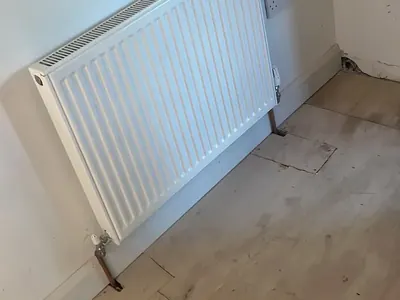
A radiator sized for a hot boiler gives out noticeably less heat at a lower temperature. That is why some rooms need a larger radiator, or a double or triple panel in place of a single, to give the output the heat loss calculation asks for. Pipework size matters too: narrow microbore pipe common in some older systems can limit flow and may need upgrading.
You do not always need every radiator changed. Often a handful of rooms, such as a north-facing living room or a bay-windowed front room, need upsizing and the rest are fine. Our radiator and heating system upgrades can be done ahead of the heat pump, which spreads the disruption.
Underfloor heating in old floors
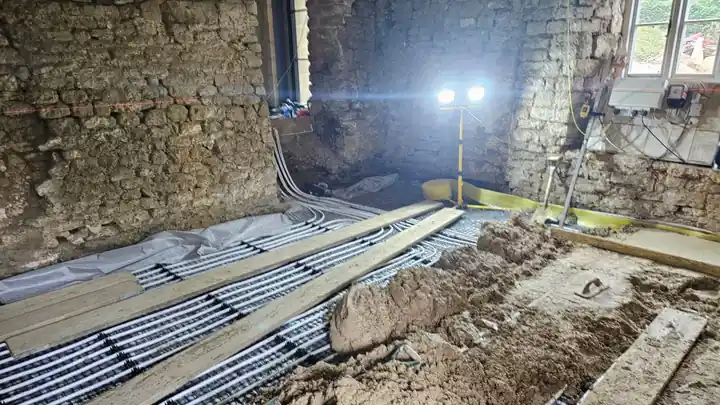
Underfloor heating suits heat pumps very well because a large warm floor gives out plenty of heat at a low flow temperature. In an extension or a room where the floor is being dug out anyway, it is often the best choice. We have fitted underfloor heating loops in stone-walled rooms where the old floor was lifted and relaid with insulation below the screed.
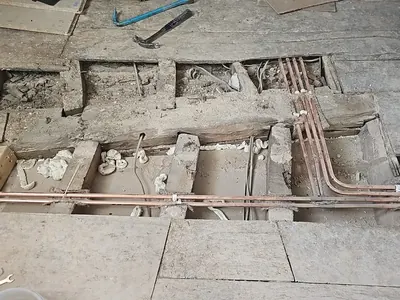
Old floors bring their own decisions. Flagstone floors laid straight on earth, suspended timber floors and limited ceiling heights all affect what system fits and how much build-up you can take. Insulation under the pipes is essential, otherwise heat goes into the ground. Our underfloor heating for old and new floors covers screed, low-profile and between-joist systems, and we will tell you if a floor is not a good candidate.
Do you need a hot water cylinder with a heat pump?
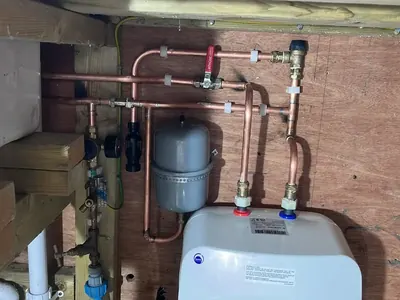
Yes. A heat pump heats water into a cylinder, so homes with a combi boiler will need room for one, usually in an airing cupboard, loft space or utility. Heat pump cylinders have a larger internal coil than standard ones so they can heat water efficiently at lower temperatures, and they include a way to periodically raise the temperature to control bacteria.
If you already have a cylinder, it is unlikely to be suitable as it stands, but the space and pipework can often be reused. Plan for the cylinder, the expansion vessel and controls taking up more room than an old copper tank.
Outdoor unit placement and noise
The outdoor unit needs clear airflow around it, a solid level base, a route for condensate water to drain away and a reasonably short pipe run to the house. Modern units are fairly quiet, but they do make a steady fan hum, so we avoid placing them right under bedroom windows or close to a neighbour's patio.
In tight terraces and gardens with steps or narrow side passages, placement can take some thought. Many installations fall under permitted development, subject to conditions (opens in a new tab)1, but it is worth checking with your local planning authority before you commit, particularly near a boundary.
Listed buildings, conservation areas, grants and when fabric work comes first
If your home is listed or in a conservation area, which is common in Cotswold towns such as Cirencester, check with your local planning authority before planning anything. Listed buildings may need consent (opens in a new tab)4 for internal changes as well as the outdoor unit, and conservation areas can have extra controls on what is visible from the street.
Government grants towards heat pumps exist, such as the Boiler Upgrade Scheme (opens in a new tab)2 run by Ofgem (opens in a new tab)3, but schemes, amounts and eligibility change. Check current eligibility on GOV.UK, and check that any installer holds whatever registrations the scheme requires before you sign anything.
The honest message is that some homes need fabric work first. If a house is very draughty, has no loft insulation or has rooms that are already hard to heat with a boiler, fixing those comes before a heat pump. Our air source heat pump systems start with that conversation, including what running costs are likely to look like, so you can decide with the full picture.
If you are wondering whether your older home is ready for a heat pump, ask us for a free survey and we will give you honest advice on fabric, radiators and running costs before any quote.
Sources and further reading
- Planning permission: air source heat pump (opens in a new tab), Planning Portal. Permitted development conditions for an outdoor heat pump unit
- Apply for the Boiler Upgrade Scheme (opens in a new tab), GOV.UK. Applying for the Boiler Upgrade Scheme and current eligibility
- Boiler Upgrade Scheme (BUS) (opens in a new tab), Ofgem. How Ofgem runs the Boiler Upgrade Scheme
- Listed buildings: other permissions you may require (opens in a new tab), Planning Portal. Consent for heat pump work on listed buildings
- Technical advice notes, including The Need for Old Buildings to Breathe (opens in a new tab), Society for the Protection of Ancient Buildings. Why solid lime-built walls need to breathe
Sources checked on 6 November 2026.
More questions
Can't see yours? Call or email and you'll speak to the people doing the work.
Often yes. Thick stone walls hold heat well once warm, which suits the steady running of a heat pump, but they can lose a lot of heat if the house is draughty or poorly insulated. A room-by-room heat loss calculation will show whether radiators need upsizing and whether breathable insulation or draught-proofing should come first.
Not usually. The heat loss calculation shows which rooms need more output at the lower flow temperature. Commonly a few radiators are swapped for larger or double panel ones while others stay. Narrow microbore pipework may also need upgrading in places. A good installer will show you room by room what changes and why.
A correctly designed heat pump will keep a suitable older home warm in winter. Problems usually come from undersized radiators, an unchecked heat loss or a very draughty house. Heat pumps run gently for long periods rather than blasting heat for an hour, so rooms feel steadily warm rather than heating up quickly.
Underfloor heating lets a heat pump run at its lowest flow temperatures, which is the most efficient set-up, and it frees up wall space. It makes most sense where floors are being lifted anyway, such as an extension or renovation. Well-sized radiators also work well and are less disruptive to fit in an existing older home.
Many air source heat pumps can be fitted under permitted development, subject to conditions about size and position. Listed buildings and conservation areas need more care, and listed buildings may need consent. Check with your local planning authority or the Planning Portal before you commit, especially if the unit will be visible from the street.
Government grants towards heat pumps exist, but eligibility and amounts change, so check the latest details on GOV.UK rather than relying on old articles. Grant schemes usually require the installer to hold specific registrations, so check those before signing anything. Grants do not replace the need for a proper heat loss design.
Related guides from our team.


Free quotes & advice
Get a no-obligation quote and straight answers about your project. Tell us about the job and we will give you straight answers and a clear written quote.
Book a site visitLines open Monday to Friday, 9am to 5pm