
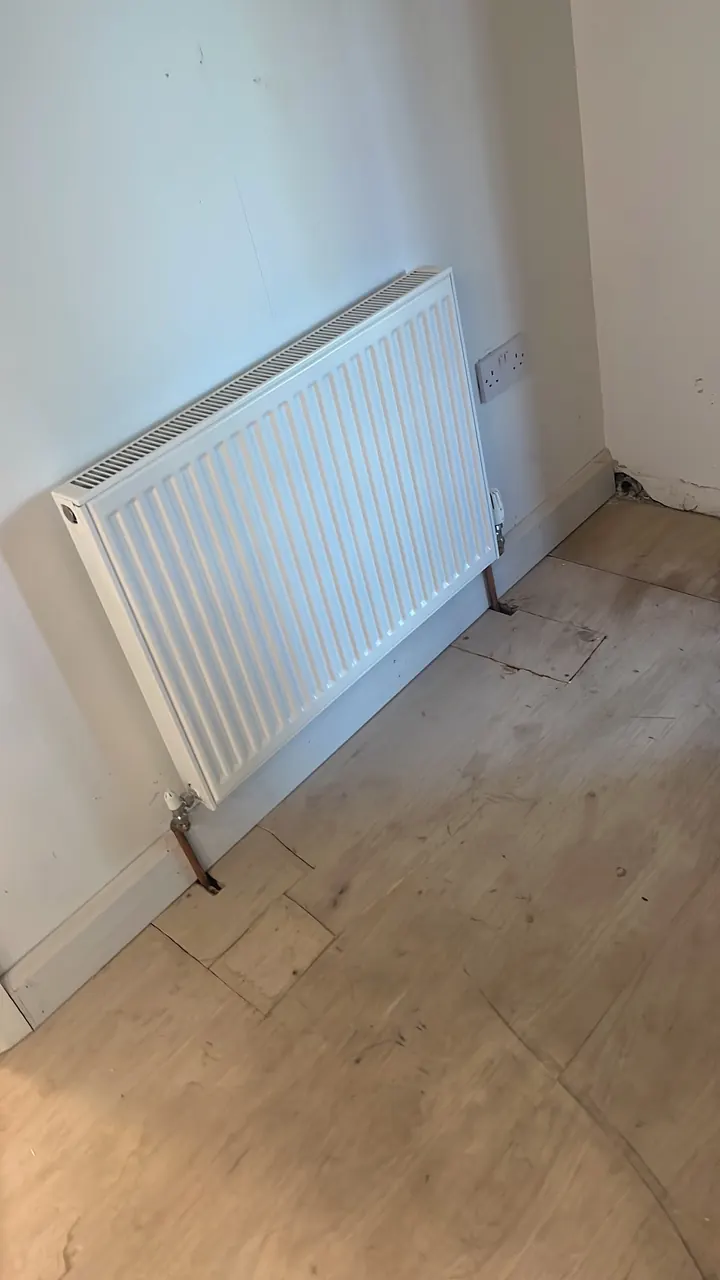
How to bleed a radiator, step by step
Turn the heating off, open the bleed valve a quarter turn until water appears, then top a combi back up to about 1 bar. Plus what to do when it goes wrong.
To bleed a radiator, switch the heating off and let it cool, hold a cloth under the bleed valve at the top corner, and turn a radiator key a quarter turn anticlockwise. Close it as soon as water spits out. On a combi or sealed system, check the boiler gauge afterwards and top up to about 1 bar with the filling loop.
Key points
- Bleeding only fixes a radiator that is cold at the top. Cold at the bottom points to sludge, so a key will not help.
- Always bleed with the heating off and the radiator cool, because the water inside can scald.
- On a combi or sealed system every bleed lets pressure out, so check the gauge and top up with the filling loop afterwards.
- If one radiator needs bleeding every few weeks, something is letting air in or making gas inside the system, and that needs finding.
- You never need to open the boiler casing to bleed radiators. Anything inside the boiler is a job for an engineer on the Gas Safe Register, so check their ID card before they start.
A radiator that is warm at the bottom and cold across the top, or one that gurgles when the heating starts, usually has air trapped in it. Letting that air out takes ten minutes and a radiator key. The part most guides rush is what happens next: on a combi boiler or any sealed system, bleeding drops the pressure, and if you do not top it back up the boiler can lock out. This post covers the steps, which radiator to start with, how to repressurise, what to do when a bleed valve misbehaves, and where the DIY job stops.
Signs a radiator needs bleeding, and when it won't help
Air collects at the highest point of a radiator, so the classic sign is a cold band across the top while the bottom is hot. Gurgling or trickling noises when the pump starts are the other giveaway. Worcester Bosch's bleeding guide (opens in a new tab)1 makes the same split: colder at the top than the bottom needs bleeding, while cold at the bottom and hot at the top points to sludge, which bleeding will not fix.
That second pattern matters, because a lot of people bleed a radiator that is cold at the bottom, get nothing but water, and assume they did it wrong. A cold bottom is almost always sludge sitting in the base of the panel. Our guide to a radiator that stays cold at the bottom walks through that diagnosis properly.
| What you feel or hear | Likely cause | Will bleeding help? |
|---|---|---|
| Cold across the top, hot below | Trapped air | Yes |
| Gurgling when the pump starts | Air in the radiator or pipework | Usually |
| Hot at the top, cold at the bottom | Sludge in the base of the panel | No |
| Whole radiator cold, others hot | Closed valve, stuck TRV pin or heavy sludge | Rarely |
| Some rooms hot, distant rooms lukewarm | System out of balance | Only as a first step |
| Every radiator cold | Boiler, pump or controls | No |
What you need and what to check first
Get everything ready before you open a valve, because once air is hissing out you will not want to go hunting for a cloth. Most bleed valves take a standard square radiator key from any hardware shop. Some newer valves have a slot for a flat screwdriver instead.
- A radiator key, or a flat screwdriver for slotted valves.
- An old cloth or kitchen roll to wrap round the key, and a small jug or cup.
- A dust sheet or towel on the floor, because the first water out can be black and it stains carpet.
- Your boiler type. A combi or system boiler with a pressure gauge on the front is sealed and will need topping up afterwards.
- Where your filling loop is. It is usually a braided hose or a lever or key under the boiler, and you want to know before the pressure drops.
How to bleed a radiator step by step
This works for panel radiators, column radiators and most towel rails. The only difference on a towel rail is that the bleed valve is on the very top of one of the uprights rather than a top corner.
- Turn the heating offSwitch the central heating off at the programmer or thermostat and wait until the radiators are cool to the touch. Worcester Bosch's steps have you turn the heating off and let the radiators cool before you open a valve, and water escaping from a hot radiator can scald. In our experience a running pump can also draw air back in through an open bleed valve on some systems.
- Find the bleed valveLook at the top corner of the radiator, on the opposite end from the pipe connections on most panels. You will see a small square spindle in a round brass or chrome fitting.
- Wrap the key and hold the jugFit the key, wrap your cloth round the valve and hold the jug just under it. A cloth catches the spray far better than a jug alone.
- Open a quarter turn anticlockwiseTurn slowly until you hear a hiss. A quarter to half a turn is plenty. On older valves the screw can come right out if you keep turning, so stop once the air is moving.
- Close it when water appearsWhen the hiss turns to spitting and then a steady dribble of water, turn the key clockwise to close. Snug it up firmly but do not force it, because the seat is soft brass.
- Repeat on any other cold-topped radiatorsWork round the house, then go back and check the first one again. A long hiss on one radiator often means more air has collected in the others.
- Check the boiler gaugeOn a sealed system, look at the pressure gauge before you turn the heating back on and top up if it has dropped. The next section covers how.
- Run the heating and feel the radiatorsTurn the heating on, give it twenty minutes, and feel each radiator from top to bottom. If the top is still cold, bleed again once it has cooled.
Which radiator should you bleed first?
Manufacturers do not agree on this. Viessmann's bleeding guide (opens in a new tab)4 says to start with the radiator furthest from the boiler, because it likely holds the most air. Baxi's advice on cold radiators (opens in a new tab)5 says to start with the one closest to the boiler, after running the heating for about fifteen minutes and then letting it cool for an hour so the air settles at the top.
In our experience the order matters far less than two other things: the system must be off and cool, and you should finish with the radiators on the top floor, because air rises through the pipework. A sensible routine is downstairs first, upstairs last, then a second pass on anything that hissed for a long time. On a sealed system, check the gauge between floors if you are bleeding several radiators, so the pressure never drops so low that the boiler locks out.
Topping up a combi or sealed system after bleeding
A combi or system boiler runs on a sealed circuit with no tank in the loft. The water in it is held under pressure, and every bit of air and water you let out of a bleed valve takes some of that pressure with it. That is why the needle on the gauge falls after a session with the radiator key. Worcester Bosch's top-up advice (opens in a new tab)7 gives 1 to 1.5 bar as the normal reading for a cool system, and its bleeding guide ends by telling you to top the boiler pressure back up, because pressure can be lost when you bleed.
To put it back, you use the filling loop. Worcester Bosch's pressure guide (opens in a new tab)2 describes the three common types: an external braided hose with two valves, a keyed internal loop under the boiler, and a keyless loop with a lever. In each case you let mains water in slowly while watching the gauge, stop at about 1 bar, then close the valves fully. In our experience, a loop left slightly open lets mains water keep creeping in until the pressure relief valve discharges through the pipe outside, so check both valves are fully shut.
Older homes with a feed and expansion tank in the loft work differently. That open-vented system tops itself up from the tank by gravity, so there is no gauge to watch and nothing to refill. If you have that kind of system and a radiator needs bleeding every few weeks, it is worth having the tank and vent pipe looked at. Our guide to boiler pressure readings covers high, low and falling pressure in more detail.
Trade tip
Pressure keeps dropping days later
One top-up after bleeding is normal. If the gauge keeps falling over the following days, water is leaving the system somewhere. Worcester Bosch suggests checking (opens in a new tab)3 radiator valves and visible joints for weeping, and looking at the relief valve pipe where it ends outside. If that is wet or dripping, Worcester says the pressure relief valve may be faulty, which is a job for an engineer.

When bleeding goes wrong
Most bleeds are uneventful. These are the problems we see most, and what to do about each.
| Problem | Likely reason | What to do |
|---|---|---|
| Nothing comes out at all | Valve blocked with paint or debris, or no system pressure | Check the gauge first. If pressure is fine, the valve may need clearing or replacing |
| Black water spits out | Iron oxide sludge from corrosion inside | Normal in small amounts. A lot of it means the system needs cleaning |
| Bleed screw came right out | Turned too far on an older valve | Push it straight back in and turn clockwise while it is still in your hand |
| Valve will not close or keeps weeping | Worn seat or damaged spindle | Shut the lockshield and the other valve (fit a manual cap if it is a TRV), then call a plumber |
| Spindle sheared off in the key | Corroded or overtightened brass | Shut the lockshield and the other valve (fit a manual cap if it is a TRV), keep a bowl under it, then get it replaced |
| Needs bleeding every week or two | Air getting in, or gas forming from corrosion | Bleeding treats the symptom. Have the cause found |
A radiator that keeps filling with air
In our experience, when one radiator needs bleeding every week or two, the cause is usually one of three things. On an open-vented system with a loft tank, the pump can push water up the vent pipe and back into the tank, which draws air in; known in the trade as pumping over. On any system, corrosion inside steel radiators can produce gas that collects at the top, and that usually comes with black water at the bleed valve. On a sealed system, a slow weep at a joint or valve that keeps being topped up brings in fresh air dissolved in the mains water.
None of these is fixed by the radiator key. Note how often you bleed and whether the gauge falls between top-ups, because that tells an engineer where to start.
Isolating a leaking radiator
Most radiators have two valves at the bottom: a manual valve or thermostatic valve (TRV) at one end, and a capped lockshield at the other. Turn the lockshield clockwise until it stops, counting the turns, because that setting controls the system balance. Turn a manual valve fully clockwise. A thermostatic head is not a reliable shut-off, because many reopen on their frost setting and some do not seal fully even at zero. Take the head off and fit the plastic manual cap that often comes with the valve, or treat the radiator as not isolated and keep a bowl under it. With both ends shut, only the water already inside the radiator can escape. Our guide to balancing radiators explains why that setting matters. If water is reaching ceilings or electrics, see our page on what to do about a leak.
Where the DIY job ends with radiators and boilers
Bleeding radiators and topping up the filling loop are user jobs. Boiler makers publish user guidance for both, and you need no special tools. Clearing out sludge, replacing a seized valve or tracking down a slow leak are a step up, and our central heating team does that work across Gloucestershire.
The line we would never cross is the boiler itself. You do not need to take the casing off to bleed anything, and you should not. If the boiler shows a fault code after you have topped up, or it keeps losing pressure, that is a boiler repair for an engineer on the Gas Safe Register, and you should ask to see their ID card.
If radiators keep filling with air or turning black inside, the long-term fix is usually a system clean and fresh inhibitor rather than more bleeding. Our post on inhibitor and power flushing explains the options.
Safety first
Gas work and gas smells
Anyone paid to work on gas appliances in a home must be on the Gas Safe Register, and the HSE strongly encourages you to check the engineer's ID card (opens in a new tab)6, which lists the appliances they can work on. If you smell gas, open doors and windows, turn the gas off at the meter if you can, and call the gas emergency number on 0800 111 999.
If bleeding has not sorted it, or the pressure will not stay up, call 07858 305739 or send us a message and we will reply within one working day.
Sources and further reading
- How to bleed a radiator (opens in a new tab), Worcester Bosch. Radiators colder at the top need bleeding, while cold at the bottom and hot at the top can mean sludge; turn the heating off and let radiators cool before bleeding; top up boiler pressure afterwards because bleeding can lose pressure
- Boiler pressure: how to repressurise your boiler (opens in a new tab), Worcester Bosch. Three filling loop types and topping up to about 1 bar, then closing both valves
- The heating system is constantly losing pressure, what should I do? (opens in a new tab), Worcester Bosch. Checking radiator valves, joints and the pressure relief valve pipe outside when pressure keeps falling
- How to bleed a radiator easily (opens in a new tab), Viessmann. Start with the radiator furthest from the boiler; may need to top up boiler pressure after bleeding
- Why are my radiators cold? (opens in a new tab), Baxi. Start with the radiator closest to the boiler after running and cooling the system; frequent bleeding can signal sludge
- Gas safety: frequently asked questions (domestic) (opens in a new tab), Health and Safety Executive. Domestic gas work must be done by a Gas Safe registered engineer; check the ID card; gas emergency number 0800 111 999
- How often should I need to top up the pressure in the heating system? (opens in a new tab), Worcester Bosch. A cool heating system should read between 1 and 1.5 bar on the gauge
Sources checked on 4 November 2026.
About this guide
Written by the team at CLA Developments, who do plumbing, heating, building and tiling work across Gloucestershire and the Cotswolds, and reviewed by Alistair Hunt, who leads the team on site. Customers on Checkatrade (opens in a new tab) mention him by name for bathroom refits, tiling and plumbing repairs. The facts were checked against the sources listed above. This is general guidance, not a survey of your home. Gas work must be done by a Gas Safe registered engineer, new electrical circuits by a qualified electrician, and structural changes need a structural engineer and building control. Spotted something out of date? Email us and we will correct it.
More questions
Can't see yours? Call or email and you'll speak to the people who do the work.
On a combi or sealed system, the boiler pressure falls and the boiler may stop and show a low pressure fault. Close the bleed valve, then top the system back up to about 1 bar using the filling loop. On an open-vented system with a loft tank, the tank refills the radiator by itself. Either way, a puddle on the floor is the main damage, so wipe it quickly because system water can stain.
Only when they need it. A quick check every autumn before the heating comes on is plenty for most homes, and Baxi notes that radiators needing frequent bleeding can be a sign of sludge. If one radiator fills with air every few weeks, something is wrong with the system and repeated bleeding just hides it.
Sometimes. Many newer bleed valves have a slot that takes a flat-bladed screwdriver. On a square spindle, a pair of pliers can work in a pinch, but they slip and round off soft brass easily, which turns a quick job into a valve replacement. Radiator keys are cheap and sold in most hardware shops, so it is worth keeping one in a kitchen drawer.
Yes, if they are connected to the central heating. The bleed valve is at the top of one of the vertical bars, often hidden under a decorative cap. Electric-only towel rails are sealed at the factory and never need bleeding. Dual-fuel rails with an electric element still need bleeding like a radiator. As with any radiator, let it cool before you open the bleed valve.
Gurgling after a bleed usually means air is still moving around the pipework, often in a high pipe run or an upstairs radiator you have not bled yet. Let the system cool and bleed the top-floor radiators again. If the noise is in the boiler itself or the pressure keeps dropping, book a boiler service so an engineer can check the pump, the automatic air vent and the expansion vessel.
Keep reading
Boilers, radiators, cylinders, heat pumps and underfloor heating.


Free quotes & advice
Get a no-obligation quote and straight answers about your project. Tell us about the job and we will give you straight answers and a clear written quote.
Book a site visitLines open Monday to Friday, 9am to 5pm