
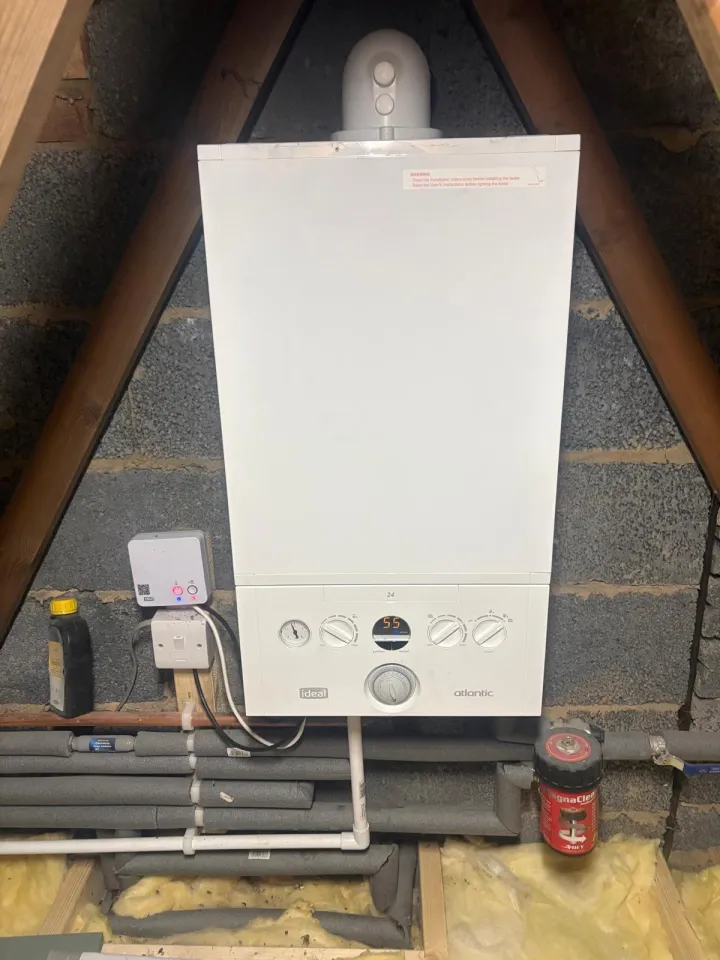
Carbon monoxide symptoms, alarms and what to do
Headache, dizziness, feeling sick and tiredness that ease outside can mean carbon monoxide. NHS symptoms, what to do now, and UK alarm rules for homes.
Carbon monoxide symptoms include a headache, dizziness, feeling sick or being sick, feeling weak, tiredness and confusion, chest and muscle pain, shortness of breath, flushing and loss of vision, according to the NHS. They may come and go, worsening indoors and easing outside. If you suspect CO, stop using the appliance, get outside, call 0800 111 999 if it is a gas appliance, and get medical advice.
Key points
- CO symptoms are easy to mistake for flu, food poisoning or tiredness; the clue is that they ease when you leave the building.
- If you suspect carbon monoxide, stop using the appliance, ventilate, get outside, call 0800 111 999 for a gas appliance, and call NHS 111, or 999 if someone is seriously unwell.
- In England, landlords must fit a CO alarm in any room used as living accommodation that has a fixed combustion appliance, other than a gas cooker.
- In England, Approved Document J says a CO alarm should go in the room, 1m to 3m from the appliance, whenever a new or replacement fixed gas (not cooking-only), oil or solid fuel appliance is installed.
- An alarm is a backstop; an annual service by a properly registered engineer is what stops an appliance producing CO in the first place.
Carbon monoxide is produced when gas, oil, coal or wood does not burn properly, and you cannot see or smell it. That is why its symptoms are easy to put down to something else. This post sets out the NHS symptoms exactly as the NHS gives them, what to do straight away, how to tell when an appliance is the problem, what the law in England says about CO alarms for landlords and for new boilers and stoves, and where an alarm should go. If anyone is unwell right now, go straight to the second section.
What are the symptoms of carbon monoxide poisoning?
The NHS lists the symptoms of carbon monoxide poisoning as follows. It also says the symptoms may come and go (opens in a new tab)1, getting worse when you spend time in an affected room or building and better when you leave or go outside.
- a headache
- dizziness
- feeling sick or being sick
- feeling weak
- tiredness and confusion
- chest and muscle pain
- shortness of breath
- your face turning hot and red (flushing), though redness may be harder to see on brown and black skin
- loss of vision
Why CO poisoning gets missed
HSE points out that early symptoms can easily be confused with food poisoning, viral infections, flu (opens in a new tab)2 or simple tiredness. Notice if you feel better away from home and worse when you return.
What to do if you think you have carbon monoxide poisoning
Act on the suspicion. You do not need to be sure, and nobody will mind being called out to a false alarm.
- Stop using the applianceThe NHS says to stop using any appliance you think might be making carbon monoxide, such as a boiler, cooker or heater, if you can. HSE adds: switch it off and shut off the gas at the meter control valve if you know where it is.
- Let fresh air in and go outsideOpen doors and windows on your way out, then get everyone, including pets, out into the fresh air.
- Call the gas emergency numberIf you think a gas appliance is leaking carbon monoxide, the NHS says to call the free National Gas Helpline on 0800 111 999 (opens in a new tab)1, which is open every day, around the clock. For oil or solid fuel, the appliance stays off until an engineer qualified for that fuel has checked it.
- Get medical adviceThe NHS says to call NHS 111 (opens in a new tab)1 if you think you might have symptoms of carbon monoxide poisoning. Tell the doctor or nurse you may have been exposed to CO.
- Do not go back inThe NHS advises not to go back into the affected building until you have got advice, and the appliance should not be used again until it has been checked and made safe.
Safety first
Call 999 or go to A&E
The NHS says to call 999 or go to A&E if someone is finding it hard to breathe, has suddenly become confused, has lost consciousness, is feeling weak, or has chest or muscle pain. Do not drive to A&E. Ask someone to drive you or call 999 and ask for an ambulance.
When a carbon monoxide alarm goes off
A full alarm, the loud alarm pattern described in your manual, means it has detected CO. Treat it exactly as a suspected leak: switch off fuel-burning appliances, open windows, get everyone outside and call 0800 111 999 if you have any gas appliance. Do not silence it and carry on, and do not assume it is faulty because nobody feels ill yet.
Many alarms also make a short chirp for a low battery or the end of the sensor's life, which is a different sound. Check the manual or the label on the back so you know which is which before you ever need to. Approved Document J expects alarms fitted under building regulations to warn you when their working life is due to pass (opens in a new tab)6, so if it is chirping and past its replace-by date, replace the whole alarm.
Signs an appliance may be producing carbon monoxide
You cannot detect CO itself, but a poorly burning appliance often leaves visible clues. HSE lists the warning signs in the first four rows below. The causes and actions are what we look for and do in practice.
| What you notice | What it can mean | What to do |
|---|---|---|
| Yellow or orange flames instead of blue (not on flame-effect fires) | Poor combustion, often a dirty burner or lack of air | Stop using it and get it checked |
| Soot, or yellow or brown staining on or around the appliance | Combustion products escaping where they should not | Switch it off and call an engineer |
| A pilot light that keeps going out | Flame or flue problem on an older appliance | Stop using it and get it checked |
| More condensation inside windows than usual | Can be a flue or ventilation problem, or just a damp room | Check for other signs and book a check |
| Smoke or fumes in the room from a stove or open fire | Blocked or poorly drawing chimney | Let the fire die, ventilate and have it swept and inspected |
| Blocked air vents or a flue terminal boxed in | The appliance cannot get or lose air safely | Clear it and have the appliance checked |
Carbon monoxide alarm regulations for landlords in England
The Smoke and Carbon Monoxide Alarm (England) Regulations 2015 were amended from 1 October 2022 (opens in a new tab)5 by the Smoke and Carbon Monoxide Alarm (Amendment) Regulations 2022. The amendment widened the CO alarm duty from solid fuel appliances to any fixed combustion appliance other than a gas cooker, added a duty to repair or replace faulty alarms, and brought social landlords into the rules. The government's guidance for landlords and tenants sets out the practical detail below.
| Requirement | What the rules say |
|---|---|
| Smoke alarms | At least one on each storey that has a room used as living accommodation |
| CO alarms | In any room used as living accommodation that contains a fixed combustion appliance, excluding gas cookers |
| What counts as an appliance | Fixed apparatus burning any fuel for heat, such as gas or oil boilers and log burners; not a decorative fireplace that cannot be used |
| Bathrooms and toilets | Count as living accommodation, so a boiler in a bathroom needs an alarm |
| Start of tenancy | Alarms checked and working on the day a new tenancy begins |
| Faulty alarms | Repaired or replaced as soon as reasonably practicable once reported and found faulty |
| Who it covers | Private and social landlords; owner-occupiers are not covered |
Enforcement, and rules outside England
The government guidance for landlords (opens in a new tab)4 says councils can serve a remedial notice, and a landlord who fails to comply with that notice can be fined. Some tenancies are excluded, such as accommodation shared with the landlord or the landlord's family, long leases and student halls; the guidance lists them all. These rules apply in England. Wales and Scotland have their own housing and building rules, which matters if you let a home over the border in Wales or Scotland, so check the Welsh or Scottish government guidance for those properties.
Building regulations Part J: a CO alarm with every new boiler or stove
Owner-occupiers are not covered by the landlord rules, but building regulations still apply when work is done. Requirement J3 of the Building Regulations, quoted in Approved Document J, says that where a fixed combustion appliance is provided in a dwelling, appropriate provision shall be made (opens in a new tab)6 to detect and give warning of carbon monoxide. The October 2022 amendments extended the carbon monoxide alarm guidance (opens in a new tab)7, which now says a CO alarm should be provided in the room whenever a new or replacement fixed gas appliance (not one used only for cooking), oil appliance or solid fuel appliance is installed. This is the guidance for England; Wales has its own Approved Document J.
The alarm should meet BS EN 50291-1:2018 and run on a battery designed to last its working life, with a warning when that life is ending. A mains-powered Type A alarm with fixed wiring is allowed as an alternative if it has a sensor failure warning, but a plug-in alarm does not qualify. So if you have a boiler replaced, a stove fitted or an oil boiler swapped, expect an alarm to be part of the job and ask for it if it is missing. Homes off the mains gas network often run on oil or wood, and those appliances are covered too.
Where to put a carbon monoxide alarm
For an alarm fitted with a new appliance, Approved Document J sets out the position. Put it in the same room as the appliance, either on the ceiling at least 300mm from any wall, or on a wall as high as possible, above any doors and windows, but not within 150mm of the ceiling. It should be between 1m and 3m horizontally from the appliance.
The landlord guidance puts it more loosely, saying CO alarms generally go at head height on a wall or shelf, about 1 to 3 metres from a potential source, and that the alarm manufacturer's instructions should be followed. Where an alarm comes with a new appliance, follow Approved Document J; otherwise follow the manual for your alarm. The NHS advice for homes is simple: get an alarm that makes a loud sound, and one for each room (opens in a new tab)1 with an appliance that burns gas, oil, coal or wood.
Trade tip
Placement mistakes we see
An alarm shut in a drawer, left on top of the boiler, tucked behind curtains or fitted next to an extractor fan or open window cannot do its job. Neither can one in the hall when the boiler is in the kitchen. Fit it in the room with the appliance, at the distance above, and test it with the button as the manual says.
Preventing carbon monoxide at the source
HSE says CO alarms are strongly recommended but should not be regarded as a replacement (opens in a new tab)3 for regular maintenance and safety checks, and that alarms should meet EN 50291 and carry a British or European approval mark. Approved Document J says the same of alarms fitted under building regulations. The alarm tells you something has gone wrong; the service is what stops it going wrong. A boiler that keeps locking out or losing its hot water is worth a look for the same reason, and our guide to a combi with no hot water covers the safe checks.
In practice that means an annual service on every gas or oil appliance, with our guide to how often a boiler should be serviced covering what a proper service includes. Have chimneys for open fires and stoves swept regularly, keep air vents and flue terminals clear, and never run a portable generator or barbecue indoors. Anyone paid to work on a gas appliance must be on the Gas Safe Register, so ask to see the ID card and check it covers the appliance in front of them.
When to call a professional
Who to call for what
Suspected CO now: 0800 111 999 and NHS 111, or 999 if someone is seriously ill. A gas boiler that has been made safe and switched off: an engineer on the Gas Safe Register. An oil boiler or stove: an engineer qualified for that fuel. A chimney: a qualified sweep.
If an alarm has gone off or a boiler has been capped after a CO scare, call 07858 305739 (Monday to Friday, 9am to 5pm) or send us a message with the make, model and fuel, and we'll tell you straight whether the job is one for us. Fault-finding sits under boiler repair, yearly checks under boiler servicing, and controls and radiators under central heating.
Sources and further reading
- Carbon monoxide poisoning (opens in a new tab), NHS. Symptom list and pattern, when to call NHS 111 or 999, what to do, causes, alarm advice for each room with a fuel-burning appliance
- Gas safety: carbon monoxide awareness frequently asked questions (opens in a new tab), Health and Safety Executive (HSE). Symptoms confused with food poisoning or flu; National Gas Emergency Service 0800 111 999; switch off and shut off at the meter; signs of a faulty appliance
- Gas safety: home owner frequently asked questions (opens in a new tab), Health and Safety Executive (HSE). CO alarms strongly recommended, not a replacement for maintenance, should meet EN 50291 with an approval mark; engineers must be on the Gas Safe Register
- Smoke and Carbon Monoxide Alarm (Amendment) Regulations 2022: guidance for landlords and tenants (opens in a new tab), GOV.UK (Ministry of Housing, Communities and Local Government). Landlord duties, fixed combustion appliance examples, bathrooms, start-of-tenancy checks, repair duty, owner-occupiers excluded, placement at head height 1 to 3 metres, enforcement
- The Smoke and Carbon Monoxide Alarm (Amendment) Regulations 2022 (SI 2022/707) (opens in a new tab), legislation.gov.uk. In force 1 October 2022; fixed combustion appliance other than a gas cooker; repair duty; social landlords included
- Approved Document J: combustion appliances and fuel storage systems (2010 edition incorporating 2022 amendments) (opens in a new tab), GOV.UK (Ministry of Housing, Communities and Local Government). Requirement J3; alarms with new or replacement gas, oil and solid fuel appliances; BS EN 50291-1:2018; battery or fixed-wired Type A; ceiling or wall position and 1m to 3m from the appliance; not a substitute for servicing
- Combustion appliances and fuel storage systems: Approved Document J (opens in a new tab), GOV.UK (Ministry of Housing, Communities and Local Government). The 2022 amendments extend the provisions and guidance for carbon monoxide alarms, taking effect on 1 October 2022
Sources checked on 4 November 2026.
About this guide
Written by the team at CLA Developments, who do plumbing, heating, building and tiling work across Gloucestershire and the Cotswolds, and reviewed by Alistair Hunt, who leads the team on site. Customers on Checkatrade (opens in a new tab) mention him by name for bathroom refits, tiling and plumbing repairs. The facts were checked against the sources listed above. This is general guidance, not a survey of your home. Gas work must be done by a Gas Safe registered engineer, new electrical circuits by a qualified electrician, and structural changes need a structural engineer and building control. Spotted something out of date? Email us and we will correct it.
More questions
Can't see yours? Call or email and you'll speak to the people who do the work.
No. The NHS says carbon monoxide is colourless and does not smell, so you cannot tell if it is around you. Any smell from a boiler or fire is something else, such as gas, which has an added odour, or smoke and fumes. That is why an audible alarm and an annual service matter: you have no natural warning.
Landlords in England are not required to fit one for a gas cooker alone, and building regulations exclude cooking-only gas appliances. The NHS still lists gas cookers among the household appliances that can produce carbon monoxide if faulty or poorly maintained, so an alarm in the kitchen is a sensible choice. Keep the cooker serviced and ventilate when you use it.
Carbon monoxide comes from burning fuel, so an electric boiler, storage heaters or a heat pump do not produce it. If nothing in your home burns gas, oil, coal or wood, the alarm rules do not apply. In our view an alarm is still worth having in a flat or terrace where a neighbour's flue or chimney runs close to your rooms. Our guide to whether heat pumps are worth it covers fuel-free heating.
It depends on the model, so check the replace-by date printed on the alarm or in the manual. Alarms fitted under building regulations should have a battery designed to last the life of the alarm and a warning when that life is ending. When it reaches that point, replace the whole unit; a new battery will not renew the sensor.
No. A smoke alarm detects smoke from a fire, and a CO alarm detects a gas with no smoke at all, so one cannot stand in for the other unless it is a combined unit made to do both. In England, landlords need a smoke alarm on every storey with living accommodation and a CO alarm in rooms with a fixed combustion appliance.
Keep reading
Boilers, radiators, cylinders, heat pumps and underfloor heating.


Free quotes & advice
Get a no-obligation quote and straight answers about your project. Tell us about the job and we will give you straight answers and a clear written quote.
Book a site visitLines open Monday to Friday, 9am to 5pm