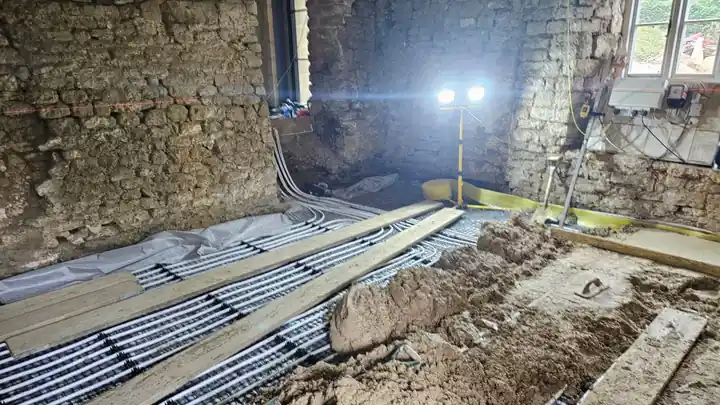
Our heat pump installers work regularly across the Forest of Dean, where many rural homes are off the gas grid and run on oil, solid fuel or electric heating. Those are the homes where a heat pump often pays its way. CLA Developments will survey sandstone cottages and bungalows alike for free and put the advice in a written quote.
“The bill was reasonable too, and the bathroom left tidy.”Checkatrade review, GL11. More reviews
A tired oil boiler or a heating bill that keeps climbing is usually what air source heat pumps in the Forest of Dean are being weighed up against. For a well-insulated home they can be a good replacement, but the result depends on the house, not the brochure. CLA Developments installs air source systems across the district, including the radiators, cylinder and pipework they need. We give honest advice on running costs first. If you hope to use a grant, check the installer's registrations before you commit, and do not assume any particular scheme will apply.
Placing an outdoor unit on a Forest hillside or lane plot
Most Forest homes have the garden space town houses lack, but the ground brings its own questions. Many villages grew along ridges and hillsides, and cold air drains downhill at night, so a unit tucked into a hollow at the bottom of a sloping garden works harder than one on a terrace higher up. It needs free airflow, a solid base and somewhere for winter condensate and defrost water to soak away without freezing across a path. On the slow-draining clays of the central Forest, that means a gravel soakaway rather than bare soil.
Noise matters in quiet valleys, particularly near bedroom windows and holiday lets. Many installs fall under permitted development, but there are conditions, and listed buildings, the district's conservation areas and homes in the Wye Valley National Landscape need more care. Check the Planning Portal or Forest of Dean District Council if you are unsure.
Heat loss in sandstone cottages and council-era bungalows
The Forest's housing splits two ways. The 19th-century sandstone cottages have thick, solid walls and often uninsulated floors laid on the ground, so they lose heat steadily and need careful room-by-room sums before a heat pump is sized. Council-built semis and bungalows, which came to dominate many Forest villages through the 20th century, are often easier, especially where cavity and loft insulation have already been added.
A heat pump works best at low flow temperatures, so each room's heat loss decides what size radiator or underfloor loop it needs. In a stone cottage, draught-proofing and loft insulation first can shrink the system. We compare running costs honestly against a year of your oil bills, and homes at the end of long rural electricity lines should check with their network operator that the supply can take the load.
Room-by-room heat loss
Radiator and underfloor sizing for low flow temperatures
Cylinder space and position
Outdoor unit siting and pipe route
Electrical supply capacity
Running-cost comparison with your current fuel
Before a heat pump survey in the Forest of Dean
Gather a full year of oil or solid fuel bills for an honest running-cost comparison
Check whether the house is listed, in a conservation area or in the Wye Valley National Landscape
Note where cold air settles in the garden on frosty mornings, to avoid placing the unit there
Find out whether the walls are solid sandstone or cavity, and what loft and floor insulation exists
Clear a space for a larger cylinder, as most Forest cottages have small airing cupboards
Ask your network operator about supply capacity if you are at the end of a long rural line
What changes when you replace oil heating with a heat pump in the Forest?
The tank goes, but a cylinder comes in: swapping an oil boiler for a heat pump frees up the tank space but adds a cylinder, usually larger than the old one, plus a buffer in some designs. In a cottage with no airing cupboard to spare, finding room is often the hardest part. Heat pumps pair well with underfloor heating where old flagstone or slab floors are being dug out, and our underfloor heating for Forest homes is designed for low temperatures. Radiator and cylinder upgrades come under our Forest heating engineer work.
Replacing oil in the Forest of Dean? Call 07858 305739 for a free survey, and have a year of fuel bills ready so we can compare running costs honestly.
Free quote
Free quote for a heat pump in the Forest of Dean
We reply within one working day, Monday to Friday, 9am to 5pm.
That didn't send, sorry. Please try again, or call 07858 305739.
Postcodes
GL14 to GL17
Council
Forest of Dean District Council
County
Gloucestershire
Typical homes
Long, shallow-plan houses, informal terraces, tall farmhouses and Chartist cottages
Our cover
Regular cover; urgent jobs depending on the day
Local conditions
What affects a heat pump in the Forest of Dean
The things about the Forest of Dean homes and ground that change how we plan and price this job, and what each one means for you.
Building materials
Carboniferous sandstone, mainly Pennant, usually coursed for building and boundary walls, with quoins in brick or dressed stone.1
We match or work with the materials your house is actually built from, so the new work sits right with the original fabric and stays sound.
The town
A district in west Gloucestershire named after the ancient woodland that covers much of it, taking in Lydney, Newent, Mitcheldean, Newnham and many villages, with Cinderford and Coleford as its other towns.2
Older streets, steep or narrow access and parking all affect how a heat pump is planned in the Forest of Dean, so we look at access at the survey and build it into the timing and the written quote.
Typical homes
Long, shallow-plan houses, informal terraces, tall farmhouses and Chartist cottages.1
Older and newer homes hide different things behind walls and under floors, so we plan a heat pump in the Forest of Dean around the house you have, not a standard job.
Forest of Dean District Council is the planning authority for the Forest of Dean. We tell you early whether your job needs planning permission or building regulations approval, and who to apply to.
We don't have a Checkatrade review from GL14 to GL17 yet. These are word for word from our jobs across Gloucestershire, each with the postcode the work was in. CLA Developments Ltd was incorporated in October 2025. Reviews dated before then, and any that mention AJH Plumbing and Heating, are from jobs done by the same team under its earlier trading name.
Fantastic Service
The boys helped us out after we had been let down by a different plumber. Really nice lads, very easy to get on with. Work carried out without any issues.
GL14January 2026
Fixing a leak from loose bath taps
This was a sudden leak. Alistair came in the evening, and thankfully was able to repair the taps so that the leak was stopped. He also did another small job, which otherwise might have led to further problems in the bathroom. He was somewhat delayed, but updated us so that we were aware, and were still very glad that he was able to come and sort the leak out straightaway. The bill was reasonable too, and the bathroom left tidy.
GL11, DursleyJanuary 2025
replacement of underground supply pipe
very prompt response and good communication. would recommend them
Was able to repair quickly, when further issues developed came straight back and sorted. Left area clean, no parts left behind. Friendly, polite and professional.
Alistair did a fantastic job. He was courteous and efficient. Left the job in a tidy state. Reasonably priced. Would highly recommend.
Fitting a new stopcockGL4July 2025
Alistair fixed our staff toilet in the office and did a great job, everything was left very clean and tidy, and he was very efficient. Would highly recommend!
Would highly recommend!GL52July 2025
CLA Developments Ltd was incorporated in October 2025. Reviews dated before then, and any that mention AJH Plumbing and Heating, are from jobs done by the same team under its earlier trading name.
It can be, but it depends on the house, the tariff and how well the system is designed. A well-insulated home with properly sized radiators can run efficiently. A draughty cottage with small radiators may not. We compare your current fuel use with a realistic heat pump estimate before recommending anything.
Somewhere with free airflow, a solid base and a short pipe run to the cylinder. Avoid hollows where cold air collects, tight corners and spots right outside bedroom windows. Condensate needs somewhere to drain without freezing across a path. We suggest positions at survey and check any planning conditions.
Many installs fall under permitted development, but there are conditions on siting and noise. Listed buildings, conservation areas and protected landscapes such as the Wye Valley National Landscape need more care. Check the Planning Portal or Forest of Dean District Council before you commit, especially near a boundary.
It can, if the design respects the building. Listed cottages in the district are typically sandstone rubble, often limewashed, with brick stacks and slate or clay tile roofs, and they need to breathe, so insulation has to be chosen with care rather than sealed on. Radiators usually need upsizing, and the outdoor unit position may need listed building consent. We work out each room's heat loss and tell you honestly if fabric work should come first.
Start with what comes out: an oil boiler and tank, or old storage heaters, each mean different work. Solid sandstone cottages lose more heat than council-era bungalows, so radiator upsizing varies widely. Hillside and lane plots can need a longer pipe run or a built-up base, and poorly drained coal measures ground affects where the condensate goes. Cylinder space in a small cottage is often the tight spot. After a free site visit we send a clear written quote.
Free quotes & advice
Get a no-obligation quote and straight answers about your project. Whether it is a dripping tap, a cold radiator or a new bathroom, we will look at the job and tell you plainly what it needs.