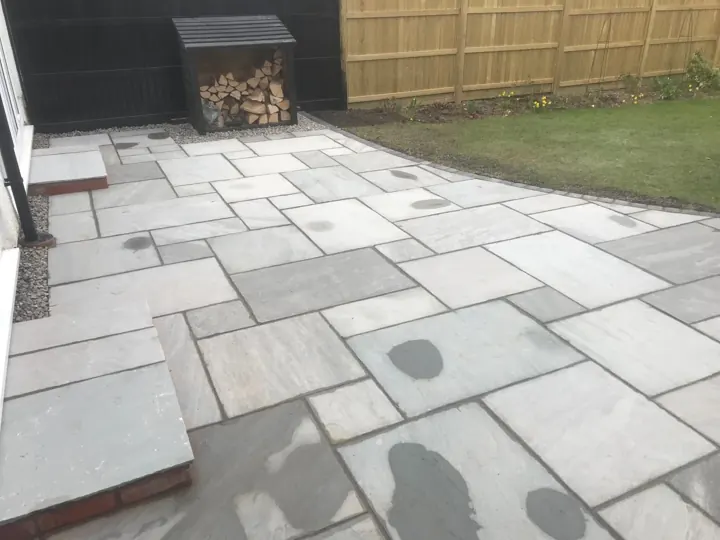
As patio installers working regularly across the Forest of Dean, CLA Developments often builds in Forest Pennant sandstone quarried near Parkend. Many homes sit on ridges and hillsides, so terraces need retaining walls or steps, and the ground switches between coal measure clays and freer-draining limestone. A free site visit settles stone, levels and drainage.
“The bill was reasonable too, and the bathroom left tidy.”Checkatrade review, GL11. More reviews
Patio installers in the Forest of Dean have a local stone right on the doorstep. Forest Pennant sandstone has been quarried here for centuries, and it sits naturally beside the stone cottages and farmhouses of the district. Porcelain is the other popular choice, harder-wearing and easier to keep clean under trees. CLA Developments lays patios, terraces, paths and entrances across the Forest. We look at the slope, the ground and where water will go before suggesting a design, then give you a written quote and a realistic schedule.
Pennant sandstone or porcelain for a Forest garden
Pennant sandstone is hard and durable, with grey, blue and buff tones that match much of the local building stone. It needs sealing in some cases, and like all natural stone it varies from slab to slab. Many people like it for exactly that reason.
Porcelain is denser, more stain-resistant and easier to clean, which matters in shady gardens under trees where algae and leaf stains build up. It needs a slurry primer on the back to bond properly to the bed. Either way, we lay on a full mortar bed rather than dots.
Ridge-top gardens, clay and limestone under a Forest patio
Many Forest villages grew along ridges and hillsides, so the back garden often falls away from the house or climbs behind it. A level terrace may need a retaining wall, steps or a split-level design. The ground underneath changes too: the clays and mudstones of the central coal basin hold water and need a deeper, well-drained sub-base, while the limestone round the western and northern rim drains freely but can be shallow and hard to dig.
Every patio needs a fall away from the house and a place for water to go: a channel drain, a soakaway tested for the soil, or a planted area. On clay a soakaway may not work at all. Leaf fall from nearby woodland blocks drains quickly, so we use channels with grates you can lift and clear.
Check levels and slope
Plan falls and water route
Dig out and lay compacted sub-base
Full mortar bed and primed slabs
Joint with a suitable mortar or compound
Clean down and walk through with you
Before we lay a patio in the Forest of Dean
Measure how much the garden falls from the back door to the far end
Find out whether the ground is heavy clay or stony limestone by digging a test hole
Check the height of the damp-proof course, or the inside floor level on an old cottage without one
Note trees overhanging the area, as Forest leaf fall and shade affect the choice of slab
Locate any septic tank, drainage field or buried supply pipe under the garden
Decide between Forest Pennant sandstone and porcelain after seeing both wet
How should a patio meet a Forest stone cottage wall?
Below the damp-proof course, or below the inside floor where there is none, so the wall stays dry. On a sandstone cottage, the patio should sit below the damp-proof course, or below the internal floor where there is none, so rain does not splash up the rubble wall. Many older Forest cottages were never built with a membrane, so we leave a gravel strip against the wall where the levels are tight. A patio often follows new building work, and laying it with our extensions in the Forest keeps thresholds in line. If you want the same tile inside and out, our Forest floor tiling can match the indoor floor.
That didn't send, sorry. Please try again, or call 07858 305739.
Postcodes
GL14 to GL17
Council
Forest of Dean District Council
County
Gloucestershire
Typical homes
Long, shallow-plan houses, informal terraces, tall farmhouses and Chartist cottages
Our cover
Regular cover; urgent jobs depending on the day
Local conditions
What affects a patio in the Forest of Dean
The things about the Forest of Dean homes and ground that change how we plan and price this job, and what each one means for you.
Ground
A basin of Carboniferous rock sitting on Old Red Sandstone, where the coal measure clays, mudstones and shales of the central coal basin give poorly drained soils.1
Ground that holds water needs a properly drained sub-base and falls away from the house, otherwise patios lift and stain; we build the base to suit.
Building materials
Carboniferous sandstone, mainly Pennant, usually coursed for building and boundary walls, with quoins in brick or dressed stone.2
We match or work with the materials your house is actually built from, so the new work sits right with the original fabric and stays sound.
The town
A district in west Gloucestershire named after the ancient woodland that covers much of it, taking in Lydney, Newent, Mitcheldean, Newnham and many villages, with Cinderford and Coleford as its other towns.3
Older streets, steep or narrow access and parking all affect how a patio is planned in the Forest of Dean, so we look at access at the survey and build it into the timing and the written quote.
Forest of Dean District Council is the planning authority for the Forest of Dean. We tell you early whether your job needs planning permission or building regulations approval, and who to apply to.
We don't have a Checkatrade review from GL14 to GL17 yet. These are word for word from our jobs across Gloucestershire, each with the postcode the work was in. CLA Developments Ltd was incorporated in October 2025. Reviews dated before then, and any that mention AJH Plumbing and Heating, are from jobs done by the same team under its earlier trading name.
Fantastic Service
The boys helped us out after we had been let down by a different plumber. Really nice lads, very easy to get on with. Work carried out without any issues.
GL14January 2026
Fixing a leak from loose bath taps
This was a sudden leak. Alistair came in the evening, and thankfully was able to repair the taps so that the leak was stopped. He also did another small job, which otherwise might have led to further problems in the bathroom. He was somewhat delayed, but updated us so that we were aware, and were still very glad that he was able to come and sort the leak out straightaway. The bill was reasonable too, and the bathroom left tidy.
GL11, DursleyJanuary 2025
New bathroom and WC room.
Alistair did a fantastic job of fitting a very snazzy new bathroom and WC room. He did some excellent tiling and did some extra plumbing work for us too. He worked very very hard and we were impressed with his work ethic. thank you
Great service at a competitive price on a difficult bathroom job from this firm, highly recommended
Toilet repairGL52July 2026
All the work was completed to a very high standard by Alaistair and Chris. They also ensured that the property was left clean and tidy after finishing the job. The job included renovating the shower room and replastering the flat. Alaistair also returned to the flat immediately when there was a minor problem and sorted it out straight away. Thank you for completing a thoroughly professional job.
Alaistair and Chris are very professional and provided excellent workmanship.GL1July 2026
We used AJH Plumbing and Heating to remove and install two bathrooms. They turned up when they said they would and despite challenges and needing to change materials part way through they worked really hard. We are very pleased with the end result.
Bathroom fittingGL3July 2026
CLA Developments Ltd was incorporated in October 2025. Reviews dated before then, and any that mention AJH Plumbing and Heating, are from jobs done by the same team under its earlier trading name.
Yes. It is a hard, durable local sandstone that has been used in the Forest for centuries, and it suits older homes. Like any natural stone it varies in colour and thickness, so slabs are laid on a full mortar bed. Some people seal it to reduce staining. We can help you compare it with porcelain.
By working out levels first, then using retaining walls, steps or split levels to create flat areas. The sub-base must be properly compacted, and each level needs a fall and a drainage route. On steep plots, retaining walls may need more structural thought, which we cover at survey.
Shade and damp let algae grow, and leaf fall keeps the surface wet. Porcelain is easier to clean than most natural stone, and a fall that sheds water quickly helps. Regular brushing and a suitable cleaner keep it under control. Good drainage stops water sitting on the surface.
Look around the district's older villages, where much of the building stone is local sandstone, and ask for samples from a supplier that stocks stone quarried near Parkend. Wet a sample to see its colour in rain, because Pennant darkens noticeably. We will lay out a few slabs at survey so you can judge them next to your house before ordering.
Stone, slope and access. Local Pennant sandstone varies from slab to slab and needs a full bed, which takes longer than porcelain. Hillside plots can need a retaining wall, a split level or steps, and clay ground under some villages needs a deeper base and somewhere for water to go. Cottages without a damp-proof course need a gravel strip against the wall. Narrow lanes affect deliveries and skips. We give a clear written quote after a free site visit.
Free quotes & advice
Get a no-obligation quote and straight answers about your project. We will help you choose tiles that suit the room and plan the layout before anything is fixed.