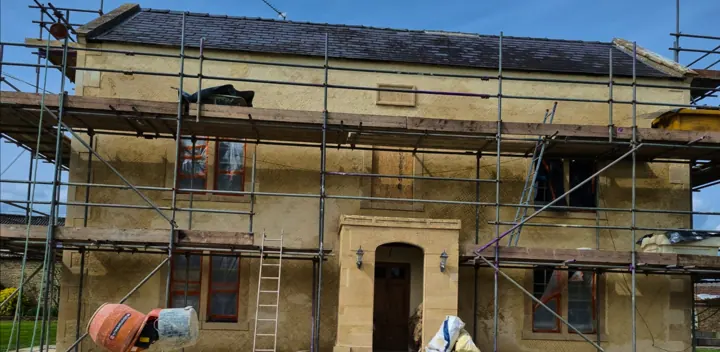
Old cement render traps rain in Ledbury's timber frames, soft Victorian brick and Wenlock Limestone rubble, so CLA Developments replaces it with breathable lime made in the local tradition. We cover the town for patch repairs and full re-rendering, and plan scaffold licences and consent. Assessing the render costs you nothing, and our quote is written.
“Alistair was quick, efficient and respectful while replacing our stop valves.”Checkatrade review, GL1. More reviews
Hairline cracks in old cement render let rain in and stop it drying out, and on Ledbury's timber-framed and soft brick houses that trapped water does real harm. Lime render, the traditional finish, works the other way: it lets the wall breathe and copes with slight movement. CLA Developments carries out lime rendering in Ledbury on stone, brick and cottage walls, patches and repairs existing render, and removes cement where it is causing damp. Photos of a thatched cottage gable we re-rendered are in our gallery.
Cement render on Ledbury's timber frames and soft local brick
Ledbury's older walls fall into three groups, and cement treats each badly. Timber-framed buildings, the black-and-white kind that line the High Street and Church Lane, have oak members with infill panels, and render over them traps water exactly where the oak meets the panel. Victorian houses in Newtown and Bridge Street were built from soft brick made in the town's own yards and laid in lime. Older cottages and boundary walls on the eastern side use rubble of local Wenlock Limestone or Malvern stone.
All three were built to get wet and dry out. Hard cement is stiffer and less porous, so it cracks as the wall moves, lets rain in and will not let it out. Removing it is careful work, cut and eased off in sections so the brick, stone or oak below is not torn away. On a listed building, check with Herefordshire Council before changing the render or finish.
Why is lime render the traditional choice in Ledbury?
Because the Wenlock Limestone above the town was burnt for lime for generations. The Wenlock Limestone of the ridge east of Ledbury was quarried for lime burning for generations, so lime render here is the local tradition, not an import. It goes on in coats: a scratch coat keyed into the wall, a floating coat to straighten it and a finishing coat, each left to firm up before the next. It must not dry too fast, so we protect fresh work with damp hessian or sheeting, and spring and early autumn are the kindest seasons.
Patching existing lime render means matching the mix and texture, then limewashing so the repair blends in. Some newer blockwork homes on the west side of town suit a modern render, and we will tell you if a job needs a specialist render system rather than lime. While the scaffold is up, repairs to sills and timbers in Ledbury can be done, and inside walls can be finished with lime plaster work in Ledbury.
Cement removed in sections without damaging the face
Lime render in three coats on old walls
Fresh work protected while it cures
Limewash or breathable paint to finish
Before re-rendering a wall in Ledbury
Check whether the building is listed or in the conservation area before changing any finish
Tap the render to find hollow areas where it has come away
Tell us whether the wall behind is timber frame, local brick or limestone rubble
Note where damp shows inside and whether it follows cracks outside
Check gutters, downpipes and ground levels, which often cause the damp
Plan the work for spring or early autumn, away from frost and hot sun
Render, scaffolding and the conservation area
Most properties in the Ledbury Conservation Area, which runs from the Homend through High Street to the Southend, are listed, and the street fronts are narrow with shops and pavements below. Scaffold on those streets may need a licence, and a change of finish on a listed front needs consent, so build both into your timetable. Behind the street, rear wings and outbuildings are often where the worst cement render sits.
Worried about cracked render or damp walls on your Ledbury home? Call 07858 305739 or email CLADevelopmentsltd@gmail.com with photos and we will come and look.
Free quote
Free quote for rendering in Ledbury
We reply within one working day, Monday to Friday, 9am to 5pm.
That didn't send, sorry. Please try again, or call 07858 305739.
Postcodes
HR8
Council
Herefordshire Council
County
Herefordshire
Typical homes
Timber-framed centre, red-brick Georgian townhouses, post-war and newer housing estates
Our cover
Regular cover; urgent jobs depending on the day
Local conditions
What affects rendering in Ledbury
The things about Ledbury homes and ground that change how we plan and price this job, and what each one means for you.
Building materials
Black-and-white timber framing, Wenlock Limestone in cottage and boundary walls and as cobbles, and Downton Castle Sandstone in parts of the church.1
We match or work with the materials your house is actually built from, so the new work sits right with the original fabric and stays sound.
The town
A small Herefordshire market town whose parish reaches into the Malvern Hills AONB, known for its black-and-white timber-framed buildings, the 17th-century Market House on its oak pillars and cobbled Church Lane.2
Older streets, steep or narrow access and parking all affect how rendering is planned in Ledbury, so we look at access at the survey and build it into the timing and the written quote.
Typical homes
Timber-framed centre, red-brick Georgian townhouses, post-war and newer housing estates.2
Older and newer homes hide different things behind walls and under floors, so we plan rendering in Ledbury around the house you have, not a standard job.
Herefordshire Council is the planning authority for Ledbury. We tell you early whether your job needs planning permission or building regulations approval, and who to apply to.
We don't have a Checkatrade review from HR8 yet. These are word for word from our jobs across Gloucestershire, each with the postcode the work was in. CLA Developments Ltd was incorporated in October 2025. Reviews dated before then, and any that mention AJH Plumbing and Heating, are from jobs done by the same team under its earlier trading name.
New tap fitting in bathroom
Prompt initial response, followed by inspection visit, quote and confirmed installation date. All handled excellently. Very smart plumber fitted the tap and was very polite and helpful.
GL4, GloucesterFebruary 2025
Electric shower repair
Alistair was very helpful in researching and finding a cost effective solution. He also fixed an access point issue at no extra cost. Thanks Alistair!
GL2, GloucesterJanuary 2025
Kitchen taps.
Alistair was quick, efficient and respectful while replacing our stop valves. He made the system more accessible and removed the unnecessary pipes that were redundant.
Really good, was able to fit the tap and carried out further work to make sure everything was working smoothly.
Kitchen mixer tap installation.GL2October 2025
Had approx 8m2 of floor tiles installed, hallway and downstairs bathroom. Job included removal and refitting of vanity unit and back to wall toilet and the install of a new heated towel rail. Very helpful, efficient and friendly company who completed the job over the weekend to fit in with our plans. Would definitely recommend.
Floor tilingGL3October 2025
Alastair was very helpful & was neat and tidy when work was carried out - would recommend 👍
You can, but it rarely lasts on an old wall. Filling cracks keeps out some rain for a while, but the render is still trapping moisture behind it, and new cracks open as the building moves. On a modern block wall, patching cement render is fine. On old brick, stone or a timber frame, replacing it with lime is usually the lasting fix.
Only once the final coat has set. Each coat needs several days to firm up before the next, longer in cool, damp weather, and the render keeps hardening for weeks afterwards. That is why lime work is planned around the seasons and kept out of frost. Limewash goes on once the final coat has set.
Often, yes, if it changes the material or appearance. Replacing cement with lime on a listed building is usually welcomed, but you should still check with Herefordshire Council before work starts. We can advise on the work itself and build any consent conditions into our method.
Usually not, unless it was rendered originally. Ledbury's Victorian houses were built from soft local brick meant to be seen, and render added later often traps damp. If cement render is failing, removing it and repointing in lime can be better than re-rendering. We look at the brick underneath before advising.
The type of wall and the street it stands on. Render over timber framing has to be detailed so water does not sit where oak meets panel, and soft Newtown brick needs cement removed with care. Narrow fronts in the conservation area, with shops and pavements below, may need a scaffold licence, and listed fronts need consent for a change of finish. Rear wings are often the worst affected. Lime needs spring or early autumn weather. We give a clear written quote after a free site visit.
Free quotes & advice
Get a no-obligation quote and straight answers about your project. We're happy to help you plan a build or renovation so it runs efficiently.