
Rendering contractors in Gloucestershire
Lime render for stone and cottage walls, render repairs and patching, with honest advice on what your walls need.
Listed on Checkatrade Member of the Association of Master Tradesmen Registered company 16784817 (opens in a new tab) Email photos of the job for a quote
As rendering contractors in Gloucestershire, CLA Developments re-renders cottages and gable ends, repairs failing render and removes damp-trapping cement render. Render protects external walls with a coat that sheds rain, and on older solid walls it needs to be lime so moisture can escape. Every job starts with a free site visit and a written quote, with no obligation to go ahead.
“Alistair did a fantastic job of fitting a very snazzy new bathroom and WC room.” Checkatrade review, GL5. More reviews
CLA Developments carry out rendering in Gloucestershire for old stone and solid-walled houses, with lime render as the default on anything built before modern cavity walls. We re-render cottages and gable ends, patch and repair failing render, and take off cement render that is trapping damp in stone, across Stroud, Cirencester, Tewkesbury, the Forest of Dean and the Cotswold villages between. Our work is external render only: the coat that keeps the weather off the wall while still letting it dry. If a building needs a specialist render system, such as an insulated render on a modern block wall, we will tell you so and suggest who to ask. Every job starts with a free survey and a clear written quote.
Rendering and render repairs across Gloucestershire
Render jobs usually fall into three groups: cracked or hollow render that needs patching, cement render on an old wall that is causing damp, and bare or weathered stone that the owner wants protected. Cotswold limestone, rubble outbuildings, timber-framed gables and Victorian brick all render differently, and the right mix for one would be wrong on another.
- Lime render on stone cottages and rubble walls
- Re-rendering gable ends and exposed elevations
- Patch repairs to cracked, hollow or blown render
- Removing cement render from old stone
- Bell-cast beads, drips and render stops above ground
- Limewash and breathable finishes over new render

Why does cement render damage old walls?
Cement render damages old walls because it is harder and far less permeable than the stone, so rain that soaks in can no longer dry out. A solid stone or old brick wall has no cavity and no membrane. It stays sound because rain that soaks into the face during wet weather dries out again in dry weather, through the mortar joints and the surface. Lime render works with that, because it is softer and more permeable than the stone.
Cement does not move with the wall, so it cracks, often in fine lines you can barely see. Rain runs in through the cracks, but the dense render around them slows the drying. The moisture that stays behind shows up indoors as damp patches, salts and failing plaster, and outside it freezes in the stone face behind the render, so when the render finally comes away the stone can come with it.
Signs the render on your house is trapping water
Look for dark staining below cracks, patches that sound hollow when tapped, bulges, and render carried down into the soil. Damp inside on the same wall, often at a similar height, is a strong clue.
Is all cement render a problem?
Not always. On modern blockwork with a cavity behind it, cement or a manufactured render system is normal and can perform well. The trouble comes when it is used on solid walls that rely on drying out. We look at the wall before recommending anything, and if the render is sound and the wall dry, we may tell you to leave it.
Before your rendering survey
- Note where cracks, stains or hollow patches are on each wall
- Check for damp patches inside on the same walls
- Look at gutters and downpipes for leaks or overflow marks
- See whether soil or paving is built up against the base of the wall
- Find out whether the house is listed or in a conservation area
- Think about the finish and colour you would like
How we apply lime render
We start by removing loose or failed render and raking out soft or crumbling joints. Any defects in the wall behind, such as loose stones, failed lintels or holes from old fixings, are repaired first. The wall is dampened so it does not pull water out of the new render too fast, and deep hollows are dubbed out so the coats go on at an even thickness.
The render goes on in coats. A haired scratch coat is pressed into the background and scored for a key, a floating coat builds out and straightens the surface, and a thinner finishing coat gives the texture, from a smooth float to a rough-cast or an uneven face that follows the stone. Each coat firms up before the next.
Lime cures slowly and needs looking after. We protect fresh render with hessian from sun, wind and driving rain, mist it so it does not dry too fast and stop work when frost is forecast. Most external lime rendering therefore happens between late spring and early autumn, with curing time built into the schedule.

Patch repairs and partial re-rendering
A good patch repair can extend the life of a render by many years. We tap the wall to map the hollow areas, cut back to firm render with square or neatly shaped edges and undercut slightly so the new material locks in. The patch is built up in the same number of coats as the original and finished to match the texture, so it disappears under limewash.
We will be straight with you about when patching stops making sense. If the render is cement and hollow in several places, each patch only moves the problem along, and taking it back to stone and re-rendering in lime is the better long-term repair. Our render repairs in Stroud page shows how that choice plays out on hillside cottages.
Render on stone cottages, gables and timber frames
Rubble stone walls were often rendered or limewashed from the start, because the stone and the joints needed protection from driving rain. Exposed gable ends take the worst of the weather, so they are the most common elevation we re-render. On the steep valley sides around our Nailsworth rendering jobs, the base of the wall gets particular attention, with the render stopped above ground on a bell-cast or drip so it cannot wick water up from the soil.
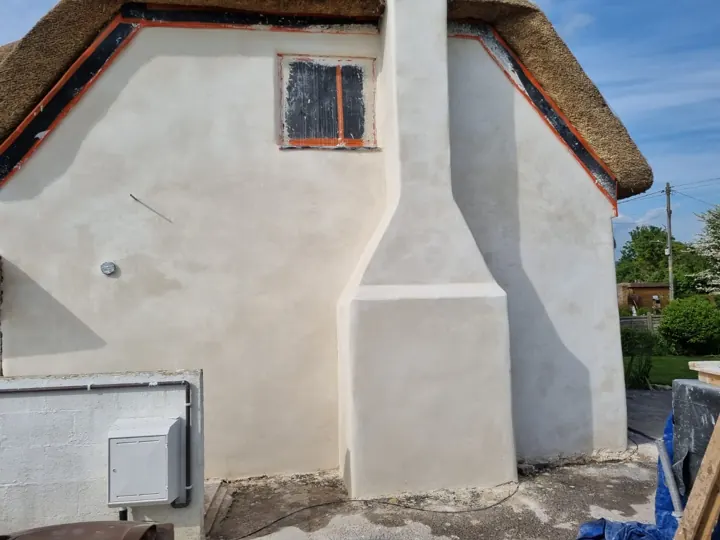
Timber-framed buildings need a flexible, breathable finish over infill panels, so lime is the right choice there too. Older market towns such as Tewkesbury have plenty of these. A thatched cottage gable we re-rendered is among the photos in our project gallery.
In Cotswold market towns, our Cirencester render work often starts with deciding which walls should be rendered at all. Listed buildings and conservation areas need more care, so check with your local planning authority before changing an external finish.
Finishes, inside walls and wider projects
Limewash is the traditional finish over lime render. It goes on in several thin coats, can be tinted with natural pigments and lets the wall breathe, while a breathable mineral paint gives a more even colour. Masonry paints that form a plastic skin trap moisture just like cement, so we avoid them on lime.
A wall that has been damp outside is usually damp inside too, and once the render is right the inside face may need lime plaster to let it dry. That is covered by our plastering and making good service, carried out by the same team. Where re-rendering is one part of putting an old house right, it fits into our period home renovations, so render, plaster, drainage and repairs are planned in the right order.
If you have cracked, hollow or damp render, or a stone wall that needs protecting, send us photos of the wall and we will arrange a free survey and a clear written quote.
Free quote for rendering across Gloucestershire
- We reply within one working day, Monday to Friday, 9am to 5pm.
- A free, no-obligation site visit.
- A clear written quote before any work starts.
Prefer to talk it through? Call 07858 305739.
Tell us about the job
Two details and we'll call you back.
That didn't send, sorry. Please try again, or call 07858 305739.

What our customers say about our building work
Alistair did a fantastic job of fitting a very snazzy new bathroom and WC room. He did some excellent tiling and did some extra plumbing work for us too. He worked very very hard and we were impressed with his work ethic. thank you
Alistair came out on a Friday night to fix a leak in my kitchen. He was professional and thorough in the midst of the emergency situation. Realising the previous plumber and kitchen fitter had done a very poor job, I then asked him to fix the nightmare situation for me which he did. The kitchen has been fine ever since. He is polite and timely and always clears up. I am very grateful to him and wouldn't hesitate to recommend his service.
We highly recommend these guys - they did everything we needed & were a pleasure to deal with. Perfect - thank you!
Alistair did a fantastic job. He was courteous and efficient. Left the job in a tidy state. Reasonably priced. Would highly recommend.
CLA Developments Ltd was incorporated in October 2025. Reviews dated before then, and any that mention AJH Plumbing and Heating, are from jobs done by the same team under its earlier trading name.
Guides about rendering
Straight answers from the people doing the work, written for homes in Gloucestershire.
Rendering in every town we cover
Pick your town for local detail on rendering there: the housing, what to expect and how quickly we can reach you.
Gloucestershire
- Renderers in Gloucester
- Renderers in Cheltenham
- Renderers in Stroud
- Renderers in Cirencester
- Renderers in Tewkesbury
- Renderers in Nailsworth
- Renderers in Wotton-under-Edge
- Renderers in Forest of Dean
- Renderers in Bishop's Cleeve
- Renderers in Dursley
- Renderers in Tetbury
- Renderers in Cinderford
- Renderers in Coleford
- Renderers in Moreton-in-Marsh
South Gloucestershire
Wiltshire
Four steps from first call to finished job
The same process whether it's a new tap or a full extension, so you always know what happens next.
- 01
On-site survey
We come out, look at the job properly and talk through what you want, including any drawings you already have.
- 02
Clear quote
A written quote with the work, the price and a realistic schedule. No obligation and no surprises later.
- 03
Design & layout
We agree the layout, materials and finishes with you before anything is ordered or removed.
- 04
Installation & work
One team carries out the work, keeps the site tidy and checks everything with you at the end.

Reviewed on Checkatrade
Every review on this site comes from a real customer.

Master Tradesmen
Members of the Association of Master Tradesmen.
Qualified tradespeople
Fully qualified, with years of hands-on experience on every job.
Guaranteed work
Guarantees on materials and workmanship.
Rendering: your questions answered
Can't see yours? Call or email and you'll speak to the people doing the work.
If the wall is solid stone or old brick and the cement render is cracked, hollow or causing damp inside, replacing it with lime is usually the right repair. If the render is sound and the wall is dry, it may be better left alone for now. We check the wall at the survey before recommending either.
Late spring to early autumn. Lime render needs to cure slowly and must not freeze before it has set, so we avoid frosty months. Very hot, dry or windy days need extra protection with hessian and misting. We plan the work around the weather and allow curing time between coats.
Usually, yes. We cut back to sound render, build up the patch in matching coats and copy the original texture. A fresh coat of limewash over the whole elevation then hides the join. Matching an old painted or weathered finish exactly without a new coat over it is harder, and we will tell you honestly.
Our work is traditional lime render, render repairs and patching on stone, brick and timber-framed walls. If your building needs a manufactured or insulated render system, such as on modern blockwork, we will tell you so at the survey and suggest you speak to a specialist installer of that system.
Usually because it runs down to the ground or behind a path, so it soaks up water from the soil and then freezes. We cut it back above ground level, fit a bell-cast bead or drip, repair in lime and suggest lowering the ground or adding a gravel strip so the wall can dry.
Like-for-like repairs often do not need permission, but changing the external finish of a listed building usually needs listed building consent, and conservation areas can have extra controls. Check with your local planning authority or the Planning Portal before work starts. We can follow any conditions set by a conservation officer.
The wall area and height decide how much scaffolding is needed. Removing old cement render, repairing the stone or brick beneath it and the number of lime coats all add time, and lime work has to wait for suitable weather, away from frost and strong sun. Detailing around windows, doors and corners, and whether the house is listed or in a conservation area, also count. We give a clear written quote after a free site visit.
Free quotes & advice
Get a no-obligation quote and straight answers about your project. We're happy to help you plan a build or renovation so it runs efficiently.
Book a site visitLines open Monday to Friday, 9am to 5pm