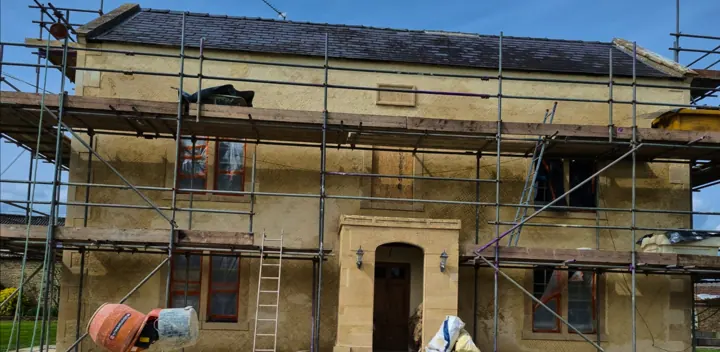
Rendering in Cinderford has to keep out driving rain, because hairline cracks in terrace render let it into the solid walls behind. CLA Developments, working regularly in the town, repairs pebbledash and cement render on brick, and uses breathable lime on the old sandstone rubble cottages of Woodside and Littledean Hill. Send us a photo of the front, and the visit and quote are free.
“Alistair was knowledgeable, reliable and punctual.”Checkatrade review, GL2. More reviews
Hairline cracks across a rendered terrace front look harmless, but in a Cinderford winter they let rain run in behind the coat and down the wall. Rendering in Cinderford covers everything from patching a front elevation on a Victorian terrace to re-rendering the back addition and repairing cement render on post-war houses. CLA Developments works out what the wall is built from before choosing the render: lime for older stone and soft brick, a modern mix where the wall is blockwork. We patch and repair, take off failing render and apply new. You get a free survey and a written quote with no obligation.
Render on Cinderford's older terraces
The older terraces were built in local sandstone, rubble stone and brick, and many were rendered at some point, either from new or by later owners. Under a cement coat there is often a solid wall that relied on drying out through its face. Once the cement cracks, water gets in and has nowhere to go.
On those walls we use lime. Where only one area has failed, we cut back and patch. Where the coat is hollow across most of the front, we take it off, let the wall dry and re-render in lime. Joining one house to the next in a row needs a neat, straight stop at the party line.
Back additions, post-war homes and repairs
The single-storey back addition on many terraces gets the worst of the weather and the least attention. Render there cracks around the window, at the junction with the main house and along the bottom where it meets the yard. If the render runs down into the paving, it wicks water up, so we finish it above ground level with a bead.
Post-war and newer homes in town are mostly brick and block. Cement-based render is fine on modern blockwork, and patching it is usually simple. Pebbledash and other textured finishes are harder to match, and sometimes a full re-coat looks better than a patch. If a wall needs a specialist render system, we will tell you.
Cracks that keep coming back may be a sign of movement or a failed lintel, which needs fixing first. Our builders in Cinderford deal with the cause.
Before we render a wall in Cinderford
Find out whether the wall under the render is sandstone rubble, brick or block, as the town's older cottages need lime.
Tap the render and mark hollow areas so we can see how much has come away.
Check gutters and downpipes, as overflowing ones on the Forest's wet side soak render fast.
Note whether the front sits on the pavement, which means a scaffold licence on the highway.
Agree with your neighbour how the render will stop at the party line on a terrace.
Plan for lime work outside frosty months on this high, exposed ground.
Do I need a licence for scaffolding on a Cinderford street?
Usually, where the front sits on the pavement, and we arrange it. A terrace front sits right on the pavement in many streets, so scaffold on the highway usually needs a licence, and we arrange it before work starts. Rear walls with no lane access mean carrying materials through the house, and we protect floors along the way.
Pennant sandstone, Forest weather and lime render in Cinderford
Pennant sandstone, the Forest's main building stone, is fairly dense, but the rubble walls of the early Woodside and Littledean Hill cottages are full of joints and voids that hold water. Cinderford sits high on the eastern edge of the Forest and takes plenty of driving rain, so a render coat on those walls has to shed water while still letting the wall dry. Lime does both; cement does the first until it cracks, then does neither.
We apply lime in thin coats, keep each one damp while it cures and avoid working in frost, which on this high ground can mean waiting for the right week in early spring or autumn. A limewash finish adds colour and protection, and it can be renewed every few years without stripping the coat.
Is the render on your Cinderford home cracking or coming away? Call 07858 305739 for a free survey. More local work is listed under our Cinderford services.
Free quote
Free quote for rendering in Cinderford
We reply within one working day, Monday to Friday, 9am to 5pm.
That didn't send, sorry. Please try again, or call 07858 305739.
Postcodes
GL14
Council
Forest of Dean District Council
County
Gloucestershire
Typical homes
19th-century miners' terraces, later 20th-century council houses and bungalows, newer private homes
Our cover
Regular cover; urgent jobs depending on the day
Local conditions
What affects rendering in Cinderford
The things about Cinderford homes and ground that change how we plan and price this job, and what each one means for you.
Building materials
Local sandstone in the older two-storey cottages, many of them of rusticated appearance.1
We match or work with the materials your house is actually built from, so the new work sits right with the original fabric and stays sound.
The town
A 19th-century industrial town on the eastern edge of the Forest of Dean that grew around the Cinderford ironworks and the Forest coalfield.2
Older streets, steep or narrow access and parking all affect how rendering is planned in Cinderford, so we look at access at the survey and build it into the timing and the written quote.
Typical homes
19th-century miners' terraces, later 20th-century council houses and bungalows, newer private homes.1
Older and newer homes hide different things behind walls and under floors, so we plan rendering in Cinderford around the house you have, not a standard job.
Conservation and listing
Cinderford itself is not among Forest of Dean District Council's conservation areas.3
Work in a conservation area or on a listed building can need consent from Forest of Dean District Council; we flag it at the survey so nothing is started that needs permission first.
Word-for-word Checkatrade reviews from our nearest jobs to Cinderford, each with the postcode the work was in. CLA Developments Ltd was incorporated in October 2025. Reviews dated before then, and any that mention AJH Plumbing and Heating, are from jobs done by the same team under its earlier trading name.
Fantastic Service
The boys helped us out after we had been let down by a different plumber. Really nice lads, very easy to get on with. Work carried out without any issues.
GL14January 2026
Replace all taps and shower bars in two bathrooms
All good. Alistair was knowledgeable, reliable and punctual. Good workmanship. Would happily recommend to others AAA*
GL2, GloucesterFebruary 2025
Leaking toilet cistern
All good. Alistair was knowledgeable, reliable and punctual. Good workmanship AAA*
Alistair was quick, efficient and respectful while replacing our stop valves. He made the system more accessible and removed the unnecessary pipes that were redundant.
Kitchen taps.GL1November 2024
It was an emergency call out in the evening and he came to us immediately. It couldn’t be fixed there and then, but he left us in a better state than we were and returned the following evening to fix it, despite being fully booked. The job was done quickly and cleanly. Great service.
Fixed radiator leakGL6November 2024
Lovely job. Worked hard to get job completed in a day. Several unexpected issues came up which were overcome quickly.
Refit downstairs cloakroomGL3November 2024
CLA Developments Ltd was incorporated in October 2025. Reviews dated before then, and any that mention AJH Plumbing and Heating, are from jobs done by the same team under its earlier trading name.
Often because the render has cracked and water is trapped behind it. Other causes include blocked gutters, a leaking downpipe and ground or paving built up against the wall. We check all of these at the survey before suggesting new render, because fixing the render alone will not cure a leaking gutter.
We can get close on texture and colour, and a painted finish helps both halves match. Where the front is one continuous coat, the join between houses needs a clean straight stop so the repair does not look patched. It helps to talk to your neighbour about doing both at once.
Small areas can be patched, but matching the stones and colour on an old dash is hard, and the repair often shows. If the coat underneath is sound, a patch and a coat of masonry paint can work. If it is hollow, re-rendering the wall is often the better long-term answer.
Spring and early autumn are usually best. Lime needs to cure slowly without frost or hot sun, and Cinderford's height on the edge of the Forest brings hard frosts in winter. We avoid rendering when frost is likely within a few days, protect fresh work with hessian or sheeting and keep it damp while it sets.
Access is a big factor: many fronts sit right on the pavement, so scaffold usually needs a highway licence, and rear walls without lane access mean materials go through the house. Then whether the render is cement on brick that can be patched, or a sandstone rubble wall better re-rendered in lime. Matching a neighbour's half of the terrace, pebbledash and back additions all add detail. Cinderford sits high, so lime needs a mild spell. We give a clear written quote after a free site visit.
Free quotes & advice
Get a no-obligation quote and straight answers about your project. We're happy to help you plan a build or renovation so it runs efficiently.