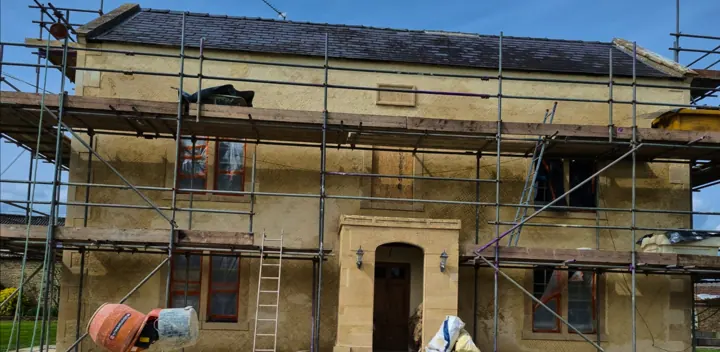
Bricklayers in Bishop's Cleeve usually face one challenge: matching 1970s and 1980s estate brick that is no longer made. CLA Developments builds extension walls, forms openings, rebuilds garden walls on the Lias clay and repairs in lime the soft old brick that refaced timber-framed cottages near St Michael's church. The survey and written quote are free.
“Very friendly and prompt at replying - would certainly recommend”Checkatrade review, GL52. More reviews
Matching a 1970s or 1980s brick that has gone out of production is the challenge most bricklayers in Bishop's Cleeve face on an extension. Estate houses were built in large batches of one brick, so a new wall in the wrong shade stands out on the whole street. We build extension walls, garden and boundary walls, form structural openings for knock-throughs and doors, and repair or rebuild damaged brickwork. In the older centre of the village, brick and stone work needs lime mortar and a lighter touch, and we take that on too. We look at the walls for free and then put a price in writing.
Where did the old brick in Bishop's Cleeve come from?
Mostly from the village itself, as brick has a long history here. From about 1660, timber-framed houses on Station Road and elsewhere were rebuilt or refaced in brick made from local clay pits along Stoke Road, and that soft, uneven brick is still visible in the old centre. Where an extension or repair meets one of those walls, a crisp machine-made brick looks wrong, so we look to reclaimed stock laid in lime.
The estates are a different problem. Post-war and 1970s to 1990s houses went up in long runs of a single brick, and many of those bricks are no longer made. We take a sample from somewhere hidden, compare it at suppliers and reclamation yards, and lay a test panel with the mortar colour before ordering. Extension walls are a brick outer leaf, insulated cavity and block inner leaf, with ties, cavity trays and weep vents, toothed in or joined with a movement joint as the engineer specifies. Our extensions in Bishop's Cleeve include all of this.
Openings in estate walls and brick-faced timber frames
In estate houses the usual opening is kitchen to dining room, or a wide door in the back wall. Many internal walls carry the upstairs joists, so an engineer sizes the steel, we prop above, cut, set the beam on padstones and make good, and building control signs it off. Our kitchen fitting in Bishop's Cleeve often follows straight on.
An opening in an older house near Church Road or Station Road needs more caution, because a brick face may hide a timber frame behind it. We open a small area first to see what the wall really is. If the house is listed, consent is needed before any wall is cut, so check with Tewkesbury Borough Council.
Before brickwork starts on a Bishop's Cleeve house
Find a spare or hidden brick we can take as a sample, as many 1970s and 1980s estate bricks are out of production
Check whether the house is in the conservation area round St Michael's church or is one of the village's listed buildings
On older houses near Station Road or Church Road, tell us if you know of timber framing behind the brick
Note trees and big hedges near a new wall, as the Lower Lias clay shrinks where roots draw out moisture
On sloping plots towards Woodmancote, watch where water runs in heavy rain before a retaining wall is designed
Have the engineer's drawings and building control reference ready for any structural opening
Garden walls and older brickwork in the village
Boundary walls between estate gardens are often only half a brick thick, with no piers and a shallow footing on clay. When they lean or crack, rebuilding with a proper footing, piers at intervals and a coping that throws water clear is the lasting fix. On sloping gardens towards Woodmancote, a retaining wall needs designing for the soil it holds back, with weep holes and drainage behind.
That didn't send, sorry. Please try again, or call 07858 305739.
Postcodes
GL52
Council
Tewkesbury Borough Council
County
Gloucestershire
Typical homes
Timber-framed and stone village core, post-war and modern estates
Our cover
Regular cover, including urgent call-outs
Local conditions
What affects brickwork in Bishop's Cleeve
The things about Bishop's Cleeve homes and ground that change how we plan and price this job, and what each one means for you.
Ground
The village was built mainly on a sandy bed in the Lower Lias, on flat ground with patches of gravel and sand.1
Footings for garden and boundary walls depend on the ground, especially clay that shrinks and swells, so we size them to the soil.
Building materials
Brick in most post-war homes, from the large Cleeve estate of mostly semi-detached brick houses to the brick bungalows and houses of the 1960s.1
We match or work with the materials your house is actually built from, so the new work sits right with the original fabric and stays sound.
The town
Large village about 4.6 miles from Cheltenham at the foot of Cleeve Hill.2
Older streets, steep or narrow access and parking all affect how brickwork is planned in Bishop's Cleeve, so we look at access at the survey and build it into the timing and the written quote.
Tewkesbury Borough Council is the planning authority for Bishop's Cleeve. We tell you early whether your job needs planning permission or building regulations approval, and who to apply to.
Reviews from customers in and around Bishop's Cleeve
Word-for-word Checkatrade reviews from jobs in GL52, each with the postcode the work was in. CLA Developments Ltd was incorporated in October 2025. Reviews dated before then, and any that mention AJH Plumbing and Heating, are from jobs done by the same team under its earlier trading name.
Would highly recommend!
Alistair fixed our staff toilet in the office and did a great job, everything was left very clean and tidy, and he was very efficient. Would highly recommend!
GL52July 2025
Friendly and prompt service
We’d been let down by other tradespeople so were really grateful when Alistair could come round and help us with a small plumbing job. Very friendly and prompt at replying - would certainly recommend
GL52July 2025
Tiled kitchen floor
Review for Alistair at AJH Plumbing & Heating Solutions. Kitchen Floor Tiling, We couldn’t be more pleased with the job Alistair did on our new kitchen floor. His workmanship is top-notch – precise and clearly carried out with great pride and attention to detail. He was faced with a few unexpected issues once the old flooring came up, but he handled each challenge swiftly and without fuss, offering practical solutions and keeping the project on track. It’s clear he knows his trade inside out. Professional, reliable, and a pleasure to have around – we wouldn’t hesitate to recommend Alistair
Alistair did a great job refitting and tiling a bathroom for us. The job was completed on time and Alistair even managed to fit in some additional small plumbing jobs which was really helpful. Alistair is straightforward and easy to work with.
Bathroom refitGL52January 2026
Great service at a competitive price on a difficult bathroom job from this firm, highly recommended
Toilet repairGL52July 2026
Alistair was efficient and tidy and did the work nicely. He worked hard to fix a new kitchen tap.
Kitchen Tap fixingGL52February 2025
CLA Developments Ltd was incorporated in October 2025. Reviews dated before then, and any that mention AJH Plumbing and Heating, are from jobs done by the same team under its earlier trading name.
We take a sample to suppliers and reclamation yards and look for the closest match or a blend of two. A test panel lets you see it with the mortar before ordering. Exact matches are rare, but a careful blend is usually hard to spot.
Yes, if the structure allows. If the wall carries load, an engineer sizes a steel or lintel, we prop the floor above and install it, and building control inspects. We make good the walls and floor afterwards, ready for the kitchen.
Usually because the footing is shallow and the clay has moved, tree roots have lifted it, or soil is piled against one side. A thin wall without piers is especially prone. Rebuilding on a proper footing with piers is normally the lasting answer.
From about 1660, owners rebuilt or refaced timber-framed houses in brick, using clay dug from pits along Stoke Road, and brick also replaced the old wattle and daub infill. Several cottages on Station Road still have a frame inside. Repairs to those walls need lime mortar and a soft brick, because hard cement and dense brick trap moisture against the old timbers.
Finding the brick and building on clay. An estate brick that went out of production may need reclaimed stock or a blend, and a test panel before anything is ordered. Garden walls on the Lias clay need a proper footing and piers. Repairs in the conservation area around St Michael's church call for soft reclaimed brick in lime mortar, and steel for an opening adds engineer and building control steps. We give a clear written quote after a free site visit.
Free quotes & advice
Get a no-obligation quote and straight answers about your project. We're happy to help you plan a build or renovation so it runs efficiently.