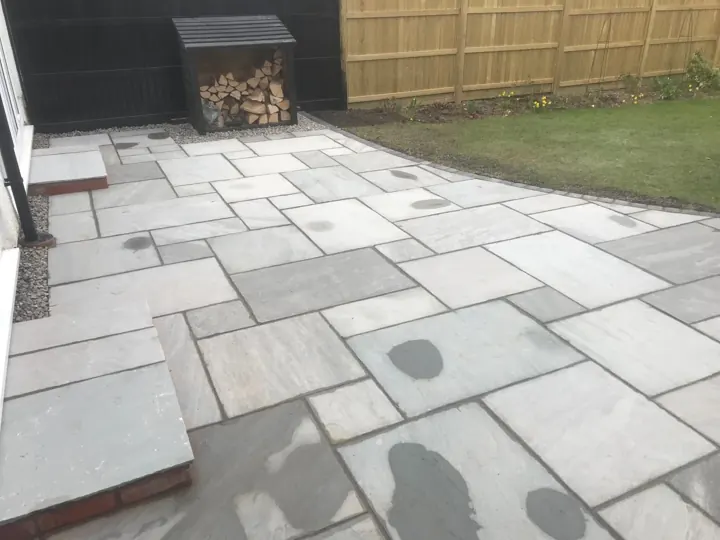
As paving contractors in Stroud, CLA Developments regularly rebuilds front steps and lays paths, from the Brick Quarter terraces around Lansdown to stone cottages on the valley sides. Many doors sit above the pavement behind a flight of steps, and older houses often have no damp-proof course, so paving stays low. Limestone or porcelain both suit. Free site visits.
“Great communication up front and the whole job was done less than 24 hours later.”Checkatrade review, GL6. More reviews
Stroud is built on the sides of five valleys, so a lot of front doors here are reached by a flight of steps from the pavement and a lot of back gardens are a stack of terraces joined by a narrow path. Our paving work in Stroud is about those routes: front steps, entrance paving, paths and garden paving in natural stone and porcelain, laid so they are safe underfoot in a wet winter and keep water away from old walls. Terraces for sitting out are covered by our patio pages, and we do not lay driveways, block paving or tarmac.
Front steps in the Brick Quarter around Lansdown
The red brick terraces of the 1860s and 1870s climb the north-west slope along Lansdown and Gloucester Street, and many front doors sit several rises above the pavement behind a low wall. After a century and a half, those flights have usually been patched so often that no two rises match, which is exactly when people miss their footing. We take the steps back to something solid, cast a new footing and rebuild with every rise and going the same, treads deep enough for a whole foot and a slight forward fall so rain runs off.
This is the Town Centre Conservation Area, so we repair in materials that suit the street and keep the bottom step on your side of the boundary with the public footway. A handrail fixed into the new flight is worth considering on the steeper ones.
How do you keep rain away from a Stroud front door?
By sloping the paving away from the threshold and keeping it low. Many of Stroud's older stone and brick houses were built without a damp-proof course, so new paving stays below the inside floor level and stops short of the wall, with a narrow strip of gravel left against the stone so it can dry. Where the ground falls towards the house, a slot or grated channel across the doorway catches the water, and our drainage team in Stroud take it to a proper outlet.
Low ground matters too. Houses by the Slad Brook flooded in 1907, 1931, 2001, 2004 and 2007, and the brook has been a rapid response catchment since 2012, rising quickly after heavy rain. On those streets we keep paving permeable where we can and make sure no new path sends extra water towards a door.
Before new paths or steps at a Stroud house
Check whether the house is in the Town Centre or Industrial Heritage conservation area before changing front steps or walls
Find your boundary where the front steps meet the public pavement
Note any spots on a garden path that stay wet after rain, a sign of spring water on the slope
Measure the rise of each existing step so we can see how uneven the flight is
Decide whether a handrail is needed on steep steps up from the street
Plan where stone and sub-base can be stored on a narrow street
Paths through terraced gardens at Whiteshill, Uplands and Rodborough
On the valley sides, gardens are often a series of levels joined by a stepped path. Rain soaks into the oolitic limestone and comes out as springs where it meets the band of Fuller's Earth clay, which can be right under a path and keeps it green and soft all winter. We dig out the wet section, put in a land drain or a deeper base of clean stone to carry the water off, then relay. On a path that climbs straight up, a gentle ramp broken by a step every few metres is easier to walk than a long slope, and the steps stop the paving drifting downhill.
Pale limestone sits well beside Cotswold stone walls and weathers in quickly; outdoor porcelain is dense, shrugs off frost and is easy to keep clean on a shaded north-facing path. We can match the paving to a terrace laid by our Stroud patio installers. We also lay paths in Nailsworth and paving in Cirencester. Our paving service covers materials and methods, and other jobs around Stroud show the rest of our work.
Need safer steps or a new path at your Stroud home? Call 07858 305739, and we will look at the slope and drainage and send a clear written quote.
Free quote
Free quote for paving in Stroud
We reply within one working day, Monday to Friday, 9am to 5pm.
That didn't send, sorry. Please try again, or call 07858 305739.
Postcodes
GL5 and GL6
Council
Stroud District Council
County
Gloucestershire
Typical homes
Stone cottages and Victorian red brick terraces with stone dressings
Our cover
Regular cover, including urgent call-outs
Local conditions
What affects paving in Stroud
The things about Stroud homes and ground that change how we plan and price this job, and what each one means for you.
Ground
Steep-sided valleys cut into the oolite plateau, with springs where permeable limestone meets the Fuller's Earth clay band on the valley sides.1
The ground under a drive or path decides the sub-base depth and how surface water is handled, so we design the base for this soil, not a standard depth.
Flood history
The River Frome at the Environment Agency's Ebley Mill gauge reached its highest recorded level, 1.40 m, on 20 July 2007.2
Where water has risen before, we think about floor levels, drainage routes and materials that tolerate getting wet, and check the flood map with you before work starts.
The town
A former cloth town at the meeting point of the Five Valleys, noted for its steep streets, with the Stroudwater Navigation and the Thames and Severn Canal.3
Older streets, steep or narrow access and parking all affect how paving is planned in Stroud, so we look at access at the survey and build it into the timing and the written quote.
Work in a conservation area or on a listed building can need consent from Stroud District Council; we flag it at the survey so nothing is started that needs permission first.
Word-for-word Checkatrade reviews from jobs in GL5 and GL6, each with the postcode the work was in. CLA Developments Ltd was incorporated in October 2025. Reviews dated before then, and any that mention AJH Plumbing and Heating, are from jobs done by the same team under its earlier trading name.
New bathroom and WC room.
Alistair did a fantastic job of fitting a very snazzy new bathroom and WC room. He did some excellent tiling and did some extra plumbing work for us too. He worked very very hard and we were impressed with his work ethic. thank you
GL5, StroudJune 2025
Shower installation
I am very happy with the work that Alistair did for me. He came within one day of me contacting him. I highly recommended him to anyone who needs a reliable and competent plumber. I will definitely use him again in the future.
GL5, StroudJune 2025
Kitchen tap replacement
Absolutely perfect. Great communication up front and the whole job was done less than 24 hours later. Couldn't have asked for any better!
Alistair came out on a Friday night to fix a leak in my kitchen. He was professional and thorough in the midst of the emergency situation. Realising the previous plumber and kitchen fitter had done a very poor job, I then asked him to fix the nightmare situation for me which he did. The kitchen has been fine ever since. He is polite and timely and always clears up. I am very grateful to him and wouldn't hesitate to recommend his service.
Excellent help in an emergencyGL5January 2026
Prompt reply to repair request, all sorted very quickly.
Toilet cistern repairGL5December 2025
We highly recommend these guys - they did everything we needed & were a pleasure to deal with. Perfect - thank you!
Yes. We take the old steps down to a sound base, pour a new footing and rebuild with even rises and treads in stone or porcelain. Where the steps meet the public pavement, we keep the bottom step within your boundary. A handrail can be fixed into the new steps if the flight is steep.
No. Driveways, block paving and tarmac are for a specialist contractor. What we lay is the foot traffic side: front steps, entrance paving, paths and garden paving in natural stone or porcelain. If you want a terrace to sit on, our patio pages cover that.
It can avoid making things worse. The brook rises quickly after heavy rain and houses beside it have flooded several times. New paving should fall away from doors, stay below the inside floor and, where possible, let water soak through rather than run off. It will not stop a flood, but it keeps everyday rain away from the walls.
Often it is spring water. On Stroud's valley sides, water soaks through the limestone and comes out where it meets clay, and that can be right under a path. Sealing over it just moves the problem. We dig out, lay a land drain or a deeper free-draining base to carry the water away, then relay the path with proper falls and edging.
Steps and slope do. Rebuilding a patched flight up from the pavement on a concrete footing takes time, and hillside garden paths need edges that stop them creeping downhill. Spring water may need a channel or cut-off drain. Materials often go up steps by hand. In the Town Centre conservation area, front walls and steps may need care with materials. Limestone takes longer to lay than porcelain. A free site visit leads to a clear written quote.
Free quotes & advice
Get a no-obligation quote and straight answers about your project. We will help you choose tiles that suit the room and plan the layout before anything is fixed.