
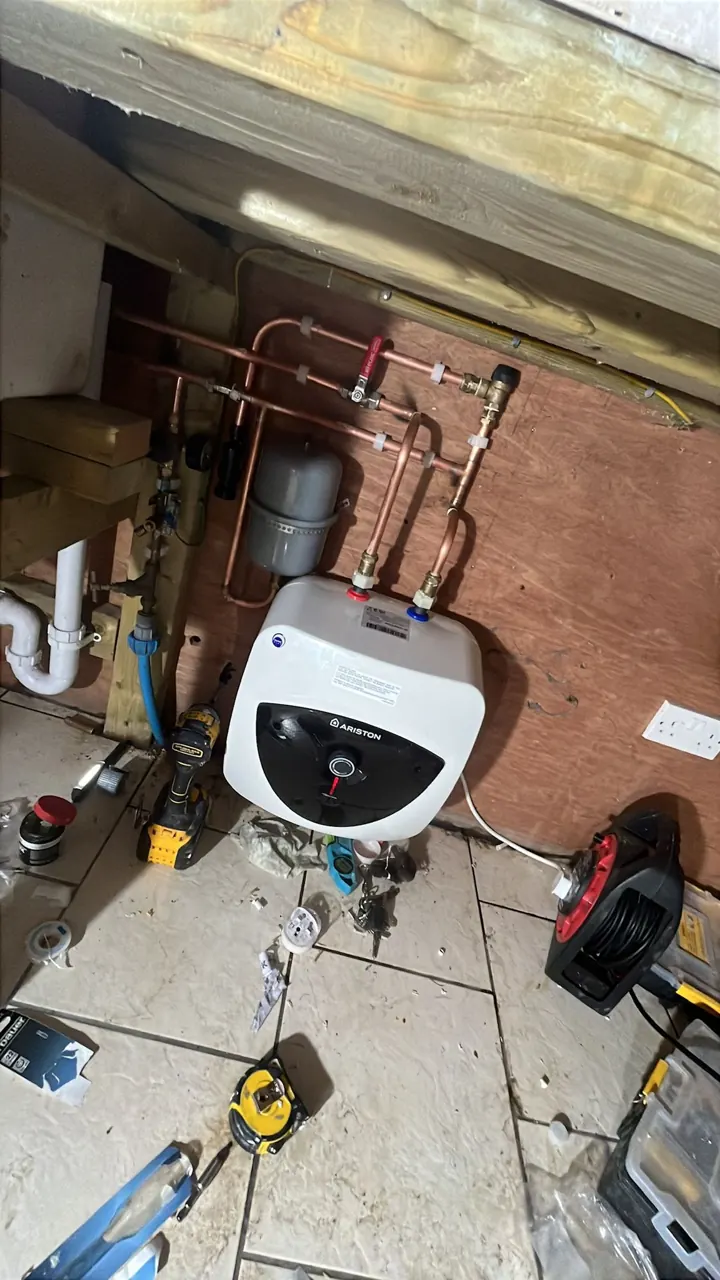
Vented vs unvented hot water cylinder: which suits your home?
An unvented cylinder gives mains pressure hot water but needs good mains flow, a G3 installer and yearly servicing. How to choose and test your supply.
An unvented cylinder is a sealed hot water cylinder fed straight from the cold mains, so taps and showers run at mains pressure with no loft tank. A vented cylinder is fed by gravity from a cold water tank in the loft. Unvented needs decent mains pressure and flow, an installer competent under Building Regulations G3, and an annual service.
Key points
- Unvented cylinders run at mains pressure; vented cylinders run at whatever pressure the height of the loft tank gives you.
- Heatrae Sadia's Megaflo eco, for example, asks for at least 1.5 bar and 20 litres a minute from the mains; check the figure for the model you are offered.
- Fitting an unvented cylinder is notifiable building work. Choose an installer who can show the skills, through a competent person scheme or an unvented skills card. Unless they are registered with a competent person scheme, building control must be notified before work starts.
- Unvented cylinders carry safety devices that must never be removed or adjusted, and the makers recommend servicing every 12 months.
- A vented cylinder is still the sensible choice where mains flow is poor or the existing set-up works well.
If you have a hot water cylinder, it is one of two kinds. A vented cylinder is fed from a cold tank in the loft and gives gentle, gravity-fed pressure. An unvented cylinder is sealed and fed from the mains, so the shower upstairs runs as hard as the kitchen tap. Swapping one for the other is a common upgrade during a bathroom refit or boiler change, but it is not right for every house. This post compares the two, shows you how to test whether your mains can cope, and explains the G3 rules and safety kit.
What is an unvented cylinder and how does a vented one differ?
A vented cylinder is open to the atmosphere. Cold water drops into it from a storage cistern in the loft, and an open vent pipe rises from the top of the cylinder back over that cistern so expanding hot water has somewhere to go. Pressure at the taps depends on the height between the loft tank and the outlet, which is why upstairs showers on vented systems are often weak.
An unvented cylinder is sealed and fed straight from the cold main through a pressure reducing valve. There is no loft tank and no open vent, so the expansion of heated water is taken up by an expansion vessel or an air bubble inside the cylinder. Because it is a sealed vessel holding hot water under pressure, the regulations treat it far more seriously.
Approved Document G (opens in a new tab)1 sets out the difference plainly. A vented storage vessel needs a vent pipe to the open air above the cold cistern plus a device to stop the stored water exceeding 100°C. An unvented vessel needs at least two independent safety devices, in addition to the thermostat, to prevent the stored water exceeding 100°C, with any discharge visible and piped somewhere safe.
| Feature | Vented cylinder | Unvented cylinder |
|---|---|---|
| Water supply | Gravity from a loft cistern | Direct from the cold mains |
| Pressure at taps | Low, set by tank height | Close to mains pressure |
| Loft space | Needs a cold tank and vent | No tanks needed |
| Showers | Weak upstairs unless pumped | Strong without a pump |
| Safety devices | Open vent plus overheat protection | Two independent devices, tundish and discharge pipe |
| Who can fit it | A competent plumber | An installer competent in unvented systems, notified under G3 |
| Servicing | Very little | Annual service recommended by makers |
Can your mains water supply run an unvented cylinder?
An unvented cylinder can only deliver what the mains gives it. Static pressure, the figure with no taps running, flatters most houses. What matters is pressure and flow together while water is running. The Megaflo eco product guide (opens in a new tab)2 gives a minimum mains supply of 1.5 bar working pressure and 20 litres a minute, and recommends a 22mm supply pipe where possible. That is one manufacturer's requirement, so check the installation guide for the model you are considering.
In older houses the weak point is often the supply pipe itself: a long run of half-inch lead or old steel from the boundary, or a pipe shared with a neighbour. That can mean replacing the supply before an unvented cylinder is worth fitting. If you already suffer weak flow, our post on low water pressure in the house covers the usual causes.
- Find the kitchen cold tapIt is normally fed directly from the mains, so it shows what an unvented cylinder would receive.
- Run it fully open into a bucketUse a bucket with litre marks, or a known volume, and time how long it takes to fill.
- Work out litres per minuteDivide the litres by the seconds and multiply by 60. Ten litres in 30 seconds is 20 litres a minute.
- Repeat at a busy timeTest again in the morning or early evening when neighbours are using water. Flow often drops noticeably at peak times.
- Let the installer check pressureA pressure gauge on an outside tap or test point shows working pressure. A good surveyor measures both before recommending anything.
The safety kit on an unvented cylinder and what each part does
An unvented cylinder comes as a factory package, and Approved Document G expects it to be supplied with its safety devices and marked with a warning not to remove or adjust any component. The parts you can see on a typical installation are these.
- Pressure reducing valve: brings incoming mains pressure down to the level the cylinder is designed for.
- Expansion vessel or internal air gap: takes up the extra volume as water heats, so pressure does not climb.
- Expansion relief valve: opens if pressure rises too far, for example when the expansion vessel loses its charge.
- Temperature and pressure relief valve: factory fitted on the cylinder; opens if the water approaches boiling.
- Non-self-resetting thermal cut-outs: cut the heat from the immersion and the boiler coil if the thermostat fails, and stay off until reset by hand.
- Tundish and discharge pipe: let you see any discharge and carry scalding water safely outside.
Discharge pipework is where DIY jobs go wrong
The guidance is precise. The tundish should be vertical, in the same space as the cylinder, lower than the valve and with no more than 600mm of pipe from the valve. Below it there should be at least 300mm of vertical pipe before any bend, then a continuous fall of at least 1 in 200, sized up for longer runs, ending somewhere a discharge of scalding water and steam cannot hurt anyone. The pipe from the tundish should be metal, or a material proven and marked for the temperature, and a high-level discharge should be at least 3m from any plastic guttering that would collect it. It is not unusual to find discharge pipes run into plastic gutters or left unfinished, and both are unsafe.

G3 regulations: who is allowed to fit an unvented cylinder?
Fitting an unvented cylinder is not a DIY job, and the law makes that clear. Approved Document G says installing an unvented system is notifiable building work, which must be notified to building control before work starts unless the installer is registered with a competent person scheme for unvented hot water. Scheme members self-certify the work and the householder receives a building regulations compliance certificate.
The same guidance tells owners to choose installers who can show the right skills, for example through a competent person scheme for this work or a current registered operative skills card for unvented hot water systems. When you get quotes, ask each installer which applies to them and how the work will be notified. Keep the certificate and the commissioning checklist; you will want them when you sell the house.
If the cylinder is heated by a gas boiler, the boiler side brings its own rules. The HSE says (opens in a new tab)4 anyone working on gas appliances in a home must be on the Gas Safe Register, and you should check the engineer's ID card before work starts. These rules cover England. Wales has its own Approved Documents, so check the Welsh guidance if you live over the border.
Safety first
If hot water pours from the tundish
A steady flow of hot water or steam from the tundish means a safety valve is doing its job. Switch off the immersion and the boiler but do not turn off the cold supply, which the Megaflo guide says to leave on. Then call an installer competent in unvented cylinders. Never cap a discharge pipe or tamper with the valves.
When a vented cylinder is still the right choice
Unvented is not automatically better. A vented system keeps working through a mains supply interruption for as long as the loft tank holds water, and Gledhill (opens in a new tab)3 notes it needs virtually no maintenance and is simpler to replace like for like.
We would usually keep a vented cylinder where mains flow fails the bucket test and the supply pipe cannot reasonably be replaced, or where there is no sensible route for a discharge pipe. It also makes sense where the household is happy with the showers as they are, or where the budget is better spent elsewhere. Weak upstairs showers on a vented system can often be fixed with a pump instead, and our post on whether you need a shower pump explains when that works.
Period and cottage properties need a little more thought. Old pipework that has only ever seen gentle gravity pressure may weep at joints when it is suddenly put on mains pressure, so part of the survey is checking what the hot water pipes are made of and how they are jointed.
Cylinders with combis, system boilers and heat pumps
A combi boiler heats water as you use it and needs no cylinder at all, which suits smaller homes with one bathroom. Once two showers run at once, a stored cylinder usually wins. Our comparison of combi and system boilers goes into that choice.
A system boiler and an unvented cylinder are a natural pair: both are sealed and both run at pressure, so the loft tanks can come out. A heat pump also needs a cylinder, and it should be one designed for heat pumps. An Installer Online article by Mixergy's chief executive, whose firm makes cylinders, explains (opens in a new tab)6 that a heat pump cylinder needs a very large coil, giving as much surface area as possible, so heat moves into the stored water while the heat pump's loop stays as cool as possible, which is where it runs most efficiently. If a heat pump is likely in the next few years, choose a cylinder now that suits one. When we plan a new boiler installation, we talk through the hot water side at the same survey.
However the cylinder is heated, the water in the primary coil is part of the heating system. Sludge in that circuit slows reheating, so the advice in our post on inhibitor and system cleaning applies to the cylinder too.
Servicing an unvented cylinder and the warning signs
The Megaflo guide recommends maintenance every 12 months by a competent person, using authorised spare parts, and says this matters most in hard water areas. A service typically checks the pressure reducing valve and strainer, the expansion vessel or air charge, both relief valves and the discharge route, and the thermostat and cut-outs. The table below covers what you might notice between services.
| What you notice | What it usually means | What to do |
|---|---|---|
| Water dripping now and then into the tundish | Expansion vessel or air charge needs recharging | Book a service soon |
| Constant hot water or steam from the tundish | Overheating; a relief valve has opened | Switch heat off, leave cold supply on, call an installer |
| Cold water running from the tundish | Pressure reducing or relief valve fault | Book an engineer |
| No hot water, boiler working | Thermal cut-out has tripped or motorised valve fault | Have the cause found before resetting |
| Brief surge or cloudy water from hot taps | Normal pressure settling or air in the water | No action if it clears quickly |
Switching from a vented to an unvented cylinder
The job starts with a survey: measuring mains pressure and flow, finding a place for the cylinder with access for servicing, and planning a discharge route to outside. The cold supply may need upsizing. Then the old cylinder and the loft tanks come out, the new cylinder and its controls go in, and the hot and cold pipework is pressure tested before the system is commissioned and notified.
Showers need checking as part of the change. A shower pump comes out: there is no tank for it to draw from, and under the Water Supply (Water Fittings) Regulations (opens in a new tab)5 a pump drawing more than 12 litres a minute from a supply pipe needs the water supplier's consent before it is fitted. Mixer showers usually improve, though the hot and cold supplies to them should be balanced. Electric showers are fed from the cold main and are not affected. If you are planning a new shower at the same time, it makes sense to design the two together, and our post on electric and mixer showers will help you choose.
Thinking about mains pressure hot water? Our cylinder and heating engineers will test your supply and tell you straight whether unvented suits your house before you commit. Book a free survey.
Sources and further reading
- Approved Document G: Sanitation, hot water safety and water efficiency (2015 edition with 2016 and 2024 amendments), Requirement G3 (opens in a new tab), GOV.UK. Vented and unvented safety requirements, factory packages and warning labels, competent installers and skills cards, notification to building control, tundish and discharge pipe rules
- Megaflo eco unvented direct and indirect hot water cylinders: product guide (opens in a new tab), Heatrae Sadia (manufacturer document, installer-hosted copy). Minimum 1.5 bar and 20 litres per minute, 22mm supply, 12-monthly maintenance with authorised spares, what to do if the relief valve discharges, normal surge and cloudiness
- Vented vs unvented cylinders: which is better? (opens in a new tab), Gledhill. Vented cylinders need virtually no maintenance and are simpler to replace like for like; unvented need an expansion vessel and annual maintenance
- Gas safety in the home: frequently asked questions (opens in a new tab), Health and Safety Executive. Gas work in homes must be done by an engineer on the Gas Safe Register; check the ID card
- The Water Supply (Water Fittings) Regulations 1999, regulation 5 (opens in a new tab), legislation.gov.uk. Notice and consent from the water undertaker before fitting a pump or booster drawing more than 12 litres per minute from a supply pipe
- Plate heat exchanger vs coil: what installers need to know (opens in a new tab), Installer Online (article by Mixergy). Heat pump cylinders need a very large coil for surface area, keeping the loop temperature low for efficiency
Sources checked on 4 November 2026.
About this guide
Written by the team at CLA Developments, who do plumbing, heating, building and tiling work across Gloucestershire and the Cotswolds, and reviewed by Alistair Hunt, who leads the team on site. Customers on Checkatrade (opens in a new tab) mention him by name for bathroom refits, tiling and plumbing repairs. The facts were checked against the sources listed above. This is general guidance, not a survey of your home. Gas work must be done by a Gas Safe registered engineer, new electrical circuits by a qualified electrician, and structural changes need a structural engineer and building control. Spotted something out of date? Email us and we will correct it.
More questions
Can't see yours? Call or email and you'll speak to the people who do the work.
The main ones are that it needs good mains pressure and flow, it must be fitted by someone competent in unvented systems and notified under building regulations, and it should be serviced every year. It also needs a safe discharge route to outside. If the mains supply is interrupted you lose hot water pressure with it, whereas a vented system can keep running from the loft tank for a while.
There is no single figure. Lifespan depends on the cylinder's build, water hardness, and whether it has been serviced. Manufacturers' guarantees on the inner vessel vary by brand and model, and most depend on annual servicing being done and recorded, so check the warranty terms for the cylinder you are offered. Valves and expansion vessels are serviceable parts that may need replacing well before the cylinder itself.
Yes. The G3 guidance in Approved Document G (opens in a new tab)1 treats installing an unvented hot water system as notifiable work, and a replacement cylinder is a new installation of one. In practice an installer registered with a competent person scheme for unvented systems notifies it for you and you receive a compliance certificate. If your installer is not in a scheme, building control must be told before work begins.
Yes. Most unvented cylinders have one or two immersion heaters fitted at the factory, either as the main heat source on direct models or as a backup on indirect ones heated by a boiler or heat pump. They must be the manufacturer's own parts with a non-self-resetting thermal cut-out. Our immersion heater guide covers timers, temperatures and faults.
Keep reading
Boilers, radiators, cylinders, heat pumps and underfloor heating.


Free quotes & advice
Get a no-obligation quote and straight answers about your project. Tell us about the job and we will give you straight answers and a clear written quote.
Book a site visitLines open Monday to Friday, 9am to 5pm