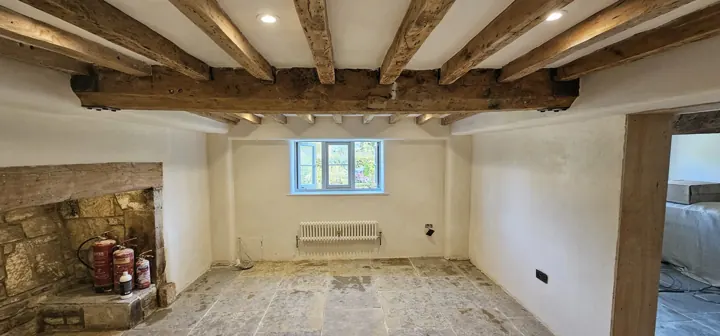
In Coleford, where we regularly work, a plasterer has to suit the plaster to the stone, and CLA Developments uses lime on the soft brown and harder Pennant sandstone walls of older cottages and gypsum on the brick and block of council homes at High Nash and Poolway. We test the walls on a free visit and put our price in writing.
“All the work was completed to a very high standard by Alaistair and Chris.”Checkatrade review, GL1. More reviews
A plasterer in Coleford has to choose the right plaster before anything else. The town's older cottages and terraces are solid Forest stone, which needs lime so the wall can dry out. The post-war and newer houses have block or brick walls and plasterboard, where gypsum is the normal finish. Using gypsum or cement on old stone is one of the most common causes of damp we see. CLA Developments plasters walls and ceilings, patches and skims, and makes good after our own plumbing and building work, so you are not left with chased walls and holes waiting for another trade.
Lime plaster on Coleford's soft and hard sandstones
Coleford's conservation area appraisal describes two main local sandstones: a durable stone, probably Pennant, on the better frontages, and a soft brown to reddish-purple stone in many back and side walls that erodes when it is trapped behind hard cement. Inside, that softer stone is where blown gypsum and crumbling plaster turn up most. Lime plaster lets the moisture that gets into a solid wall leave again, so the stone and the finish both last.
We take failed plaster back to the stone, rake out loose joints and repoint in lime, then apply lime plaster in coats with time to cure between them. It is slower than a gypsum skim, but on an old Coleford wall it is the finish that lasts, and breathable paints are the right choice on top.
Not every damp patch is the wall. A leaking pipe in a wall or a blocked gutter outside can look the same, so we check those first.
Do Coleford's council-built houses need lime plaster too?
No: their brick or block walls take gypsum as normal. The houses built by the council at High Nash, Tufthorn Avenue and Victoria and Albert Roads between the 1920s and 1940s, and the estates that followed towards Poolway and Coalway, have brick or block walls where gypsum is the normal finish. Plastering there is usually making good: patching after a radiator move, filling chases after rewiring or re-boarding a ceiling after a leak. We match the existing finish so the repair disappears under paint.
On these estates a refit usually means new pipe and waste routes chased through block, so we fill and patch those ourselves. Where a wall is getting tiles, a smooth skim is the wrong base; we leave a keyed, flat surface and our Coleford tiling work goes straight on.
Before plastering work in a Coleford house
Tell us whether the walls are solid sandstone or brick and block, as it decides between lime and gypsum.
Check outside the damp wall for blocked gutters, cracked render or hard cement pointing on the stone.
If the building is listed, ask the council before removing old lime plaster or lath ceilings.
Let any wall soaked by a leak dry out before we plaster, and tell us when the leak was fixed.
Clear furniture back from walls and ceilings being worked on.
Choose breathable paint for lime plaster before the decorating is booked.
Plaster in a Coleford renovation or listed building
Lime plastering often comes as one stage of a cottage renovation in Coleford, after joist repairs, new pipe runs and rewiring are finished, so nothing has to be chased back out of fresh plaster.
The conservation area holds about 17 listed building entries covering 21 properties. In those, historic lime plaster and lath ceilings are part of what is protected, so we repair rather than strip where we can and suggest you check with Forest of Dean District Council first.
That didn't send, sorry. Please try again, or call 07858 305739.
Postcodes
GL16
Council
Forest of Dean District Council
County
Gloucestershire
Typical homes
Older town centre, council estates from the 1940s onwards such as Sunny Bank, late 20th-century private estates
Our cover
Regular cover; urgent jobs depending on the day
Local conditions
What affects plastering in Coleford
The things about Coleford homes and ground that change how we plan and price this job, and what each one means for you.
Building materials
Exposed squared and coursed sandstone in the centre, much of it later lime-washed, rendered, roughcast or pebble-dashed.1
We match or work with the materials your house is actually built from, so the new work sits right with the original fabric and stays sound.
The town
Market town of about 9,300 people (2021 Census) in the west of the Forest of Dean, a couple of miles from the Welsh border and the Wye Valley, which grew on iron ore, coal and limestone.2
Older streets, steep or narrow access and parking all affect how plastering is planned in Coleford, so we look at access at the survey and build it into the timing and the written quote.
Typical homes
Older town centre, council estates from the 1940s onwards such as Sunny Bank, late 20th-century private estates.3
Older and newer homes hide different things behind walls and under floors, so we plan plastering in Coleford around the house you have, not a standard job.
We don't have a Checkatrade review from GL16 yet. These are word for word from our jobs across Gloucestershire, each with the postcode the work was in.
Fantastic Service
The boys helped us out after we had been let down by a different plumber. Really nice lads, very easy to get on with. Work carried out without any issues.
GL14January 2026
Alaistair and Chris are very professional and provided excellent workmanship.
All the work was completed to a very high standard by Alaistair and Chris. They also ensured that the property was left clean and tidy after finishing the job. The job included renovating the shower room and replastering the flat. Alaistair also returned to the flat immediately when there was a minor problem and sorted it out straight away. Thank you for completing a thoroughly professional job.
GL1, GloucesterJuly 2026
Gutted old bathroom including floor and timing then fitted new suite, floor, walls etc
I was so nervous about this project. I was on a tight budget but knew what I wanted and Andy was fantastic from start to finish. Super reliable, excellent communication, highly skilled and trustworthy I now have a gorgeous bathroom and can’t recommend him highly enough. Every tradesperson he used was excellent at their job and his supervision and advice made the whole process easy, and both time and cost efficient. Brilliant work, trustworthy, honest and hard working. I hope this review makes Andy blush, he should be proud.
On solid stone walls, lime is usually the right choice because it lets the wall breathe and dry out. Gypsum is fine on internal stud walls, plasterboard and modern block. We look at what the wall is made of and what is on it now before recommending a finish.
Longer than gypsum. Each coat needs time to cure before the next, and the finished wall should be left to dry before painting, often several weeks depending on the weather and ventilation. We build that into the schedule so it does not hold up other work.
Yes. Patching chases, holes and damaged plaster after electricians or other trades is a regular job for us. Send a few photos of the areas and we can usually give you a rough idea of the work before we visit.
Often because the wall is a soft local sandstone sealed with gypsum inside or cement outside. Moisture gets trapped, salts build up and the plaster lets go. We check for leaks and gutters first, then replace the failed areas with lime so the wall can dry.
Which sandstone the wall is built from and how wet it is. The soft brown to reddish-purple stone in many back and side walls is where gypsum blows worst, so it often needs stripping and replacing in lime, with drying time. Walls at the bottom of a sloping plot can be damp. A skim or patch in a 1920s to 1960s council-built house is quicker. Listed buildings near the Market Place need matching lime work. We send a clear written quote after a free site visit.
Free quotes & advice
Get a no-obligation quote and straight answers about your project. We're happy to help you plan a build or renovation so it runs efficiently.