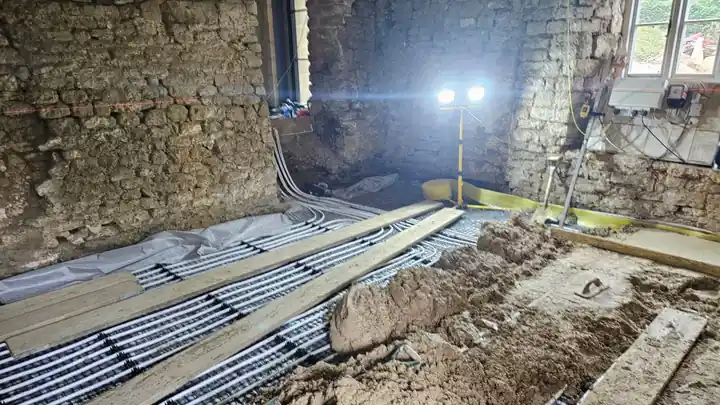
On Coleford's higher ground at Coalway and Berry Hill, winters bite harder than in the Severn Vale, so underfloor loops need sizing for it. We regularly work across the Forest, and CLA Developments fits screeded and low-profile systems in cottages, terraces and extensions. Start with a free site visit and a no-obligation quote.
“The boys helped us out after we had been let down by a different plumber.”Checkatrade review, GL14. More reviews
Underfloor heating in Coleford works best when it goes in while a floor is already up. That might be an old solid floor in a stone cottage being dug out to add insulation and a damp-proof membrane, a new extension, or a bathroom refit on timber joists. CLA Developments designs and installs wet underfloor heating systems, connects them to your boiler or heat pump, and finishes the floor with tiles or another covering. We look at heat loss, floor build-up and door thresholds at survey, so the system heats the room properly and the floor still meets the rooms around it.
Underfloor heating in Coleford's older floors
Many cottages and older terraces in Coleford have solid ground floors laid straight onto earth or rubble, often cold, sometimes damp and with no insulation at all. Putting underfloor heating on top of that wastes heat into the ground. The better approach is to dig the floor out, lay a membrane and rigid insulation, then pipe and screed it. It is a bigger job, but the room ends up warmer, drier and cheaper to heat.
Digging down in an old house needs care. We check the depth of the wall footings before we go below them and keep the new floor level with the thresholds in the rest of the house. On stone walls we leave a perimeter strip and keep the floor build-up breathable at the edges where it meets lime-pointed masonry.
Where a floor is suspended timber, we fit the pipes between the joists with spreader plates or use a low-profile overlay board. That keeps the floor height almost unchanged, which matters in rooms with low doorways.
Does underfloor heating work in Coleford's colder, higher spots?
It does, provided the loops are sized for the weather. Coleford sits on the limestone hills of the western Forest, and the higher parts of the town at Coalway, Berry Hill and Lords Hill are more exposed than the Severn Vale, so we use a lower outside design temperature when we work out each room's heat loss. Pipe spacing, the number of loops and the flow temperature all follow from that figure, and in a solid sandstone house the walls take longer to warm through.
If a heat pump is likely one day, we lay the pipes at tighter centres so the floor can run warm rather than hot, and a boiler copes happily with the same layout. Outlying homes on oil thinking about a change of fuel should design for a heat pump now; see Coleford heat pump installs for how a survey works.
Every room or zone is controlled separately from a manifold, blended down by a mixing valve on a boiler system. A new screed must cure for weeks and then be warmed slowly, which can matter if you are hoping to move back into a room before a Forest winter sets in.
Before underfloor heating goes into a Coleford floor
Find out whether the ground floor is solid, flagged or suspended timber, as each needs a different build-up.
Look for original stone flags under carpet or concrete that you may want relaid on top.
Check door and threshold heights, since insulation and screed raise a dug-out floor if it is not taken deep enough.
In a listed building, ask the council before lifting historic floors.
Tell us the heat source now and any plan to switch to a heat pump.
Choose the floor finish early, as thick carpet reduces output.
Flags, tiles and floor finishes over Coleford underfloor heating
Tile and stone pass heat quickly, so they are the best finishes over underfloor heating, while thick carpet and underlay work against it. Where an older house has original stone flags under later concrete, they can sometimes be lifted, the floor insulated and heated, and the flags relaid on top. In a listed building, check with Forest of Dean District Council before lifting historic floors.
That didn't send, sorry. Please try again, or call 07858 305739.
Postcodes
GL16
Council
Forest of Dean District Council
County
Gloucestershire
Typical homes
Older town centre, council estates from the 1940s onwards such as Sunny Bank, late 20th-century private estates
Our cover
Regular cover; urgent jobs depending on the day
Local conditions
What affects underfloor heating in Coleford
The things about Coleford homes and ground that change how we plan and price this job, and what each one means for you.
Water hardness
Coleford's mains water is hard (about 211 mg/l as CaCO3, Severn Trent's Bigwell supply zone; the Lydbrook zone to the north is very hard at about 335 mg/l).1
Hard water scales up boiler heat exchangers and system parts, which cuts efficiency. We check for it during underfloor heating in Coleford and fit a scale reducer or filter where the manufacturer recommends one.
Building materials
Exposed squared and coursed sandstone in the centre, much of it later lime-washed, rendered, roughcast or pebble-dashed.2
Solid stone walls, timber floors and lime plaster change how pipes are routed, fixed and boxed in, so for underfloor heating in Coleford we plan pipe runs around the fabric rather than chasing through it.
The town
Market town of about 9,300 people (2021 Census) in the west of the Forest of Dean, a couple of miles from the Welsh border and the Wye Valley, which grew on iron ore, coal and limestone.3
Older streets, steep or narrow access and parking all affect how underfloor heating is planned in Coleford, so we look at access at the survey and build it into the timing and the written quote.
We don't have a Checkatrade review from GL16 yet. These are word for word from our jobs across Gloucestershire, each with the postcode the work was in. CLA Developments Ltd was incorporated in October 2025. Reviews dated before then, and any that mention AJH Plumbing and Heating, are from jobs done by the same team under its earlier trading name.
Fantastic Service
The boys helped us out after we had been let down by a different plumber. Really nice lads, very easy to get on with. Work carried out without any issues.
GL14January 2026
Full bathroom refurbishment
Alistair provided a very good and full service, plumbing, tiling and fitting. At every step he made sure we were happy with the plans and discussed fully the options when changes needed to be made. I recommend him without hesitation.
GL12, Wotton-under-EdgeMay 2025
Fixing a leaky toilet
Had a problem in a new house with a leaky toilet in the week before Christmas. Extremely pleased with this company, came out in the evening and fixed the problem which was not as straightforward as it seemed. Very reasonable rate for the job. Highly recommend.
Absolutely perfect. Great communication up front and the whole job was done less than 24 hours later. Couldn't have asked for any better!
Kitchen tap replacementGL6February 2025
Alistair was efficient and tidy and did the work nicely. He worked hard to fix a new kitchen tap.
Kitchen Tap fixingGL52February 2025
This was a sudden leak. Alistair came in the evening, and thankfully was able to repair the taps so that the leak was stopped. He also did another small job, which otherwise might have led to further problems in the bathroom. He was somewhat delayed, but updated us so that we were aware, and were still very glad that he was able to come and sort the leak out straightaway. The bill was reasonable too, and the bathroom left tidy.
Fixing a leak from loose bath tapsGL11January 2025
CLA Developments Ltd was incorporated in October 2025. Reviews dated before then, and any that mention AJH Plumbing and Heating, are from jobs done by the same team under its earlier trading name.
Yes, and a cottage floor being dug out is one of the best times to fit it. We lay insulation and a membrane before the pipes and screed, which also helps with cold and damp floors. Where the floor is timber, we can fit pipes between the joists instead.
It depends on the system. A dug-out solid floor can finish at the same level as before, and many older Forest stone cottages have solid ground floors where digging out is the natural route. An overlay board on an existing floor adds a small amount, plus the tile and adhesive. We check thresholds and door heights at survey, so you know before work starts.
Very well, as long as it is designed for one. Heat pumps run at lower temperatures, so the pipes are laid closer together and the floor needs good insulation underneath. A system designed this way also works well on a gas boiler.
Often, yes. We lift and number the flags, dig out, lay a membrane, insulation and the heating in a screed, then relay the flags on top. It keeps the character of the floor and makes the room warmer. In a listed building, check with Forest of Dean District Council before the floor comes up.
The biggest factor is whether an old solid floor must come up. Many Coleford cottages have floors laid on earth or rubble, so digging out, a membrane, insulation and screed come before any pipe. On the exposed higher streets, loops may need closer spacing and more insulation. Relaying flagstones takes longer than tiling, and the heat source, whether oil, gas or a heat pump, changes the controls. You get a clear written quote after a free site visit.
Free quotes & advice
Get a no-obligation quote and straight answers about your project. Whether it is a dripping tap, a cold radiator or a new bathroom, we will look at the job and tell you plainly what it needs.